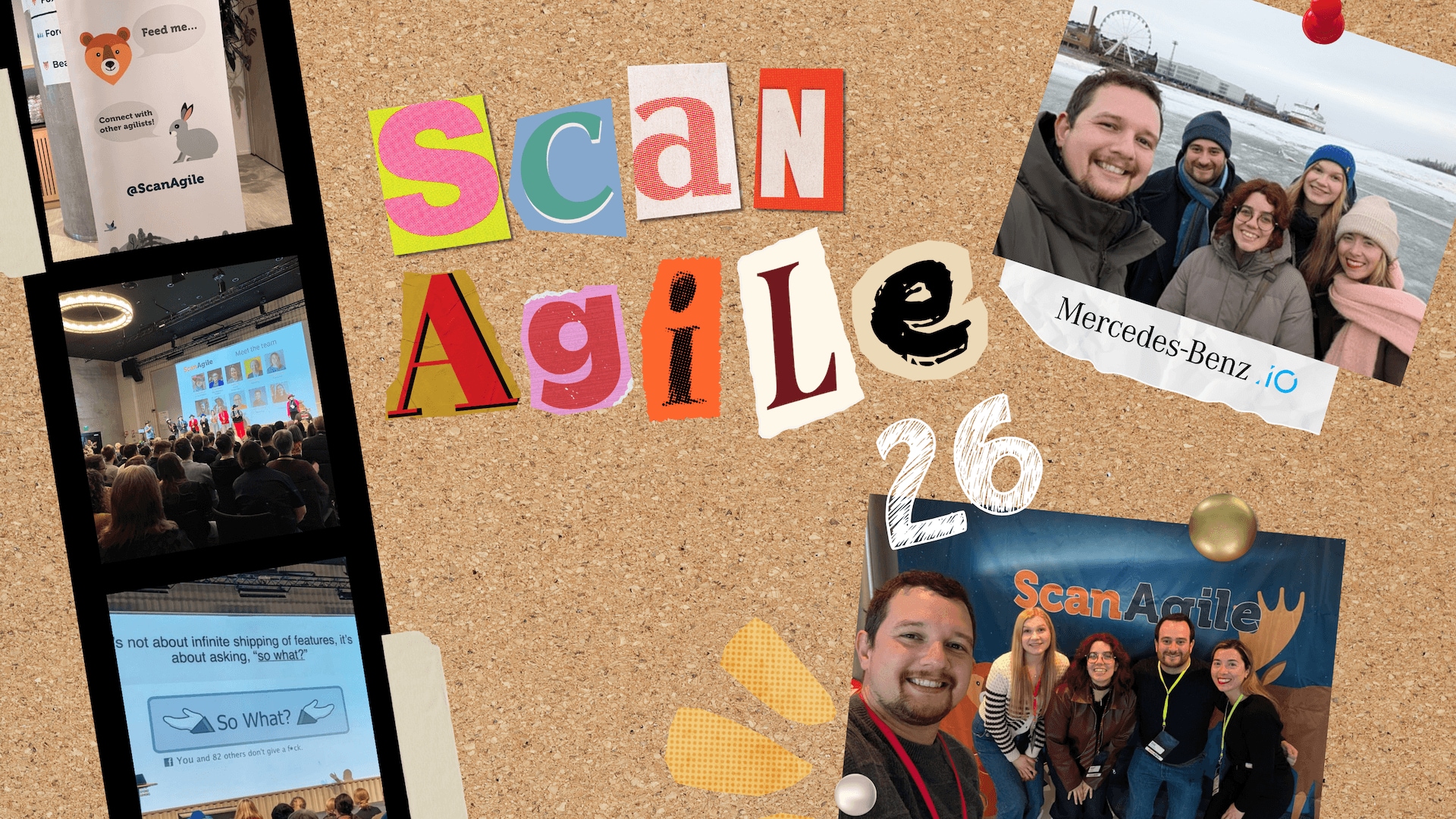
ScanAgile 2026: What Our MB.ioneers Brought Back on Agility, AI and Shared Ownership
At ScanAgile 2026, Vera Figueiredo (Scrum Master) and Alexandra Teixeira (Product Owner) explored what agility at scale really means today. Coming from different roles but facing similar complexity, they’ve returned with insights that connect systems thinking, emerging technology and the very human reality of product leadership.
Their experiences converge on one central theme: agility is not about doing more, but about removing what gets in the way of value, whether that’s systemic issues, unnecessary work or misaligned expectations.
Contents
From Symptoms to Systems: Seeing the Real Problem
A recurring reflection from ScanAgile 2026 was how often organisations try to fix visible problems without addressing their root causes.
Vera found this particularly evident in the session on the Current Reality Tree (CRT):
Teams often hit the same walls, slow delivery, frustrated customers, endless finger‑pointing and try to fix only the obvious symptoms in retrospectives. The CRT approach reminded me that treating symptoms rarely solves the real problem.
By mapping cause‑and‑effect relationships, CRT encourages teams to step back and understand the system they are operating in.
For Alexandra, systemic issues often surface when strategy and execution are not truly connected. This became especially clear during the talk OKRs meet Flight Levels, which shifted how she thinks about agility at scale.
What really stood out for me was how often organisations define ambitious OKRs, but they remain completely disconnected from the day‑to‑day work of teams.
The session highlighted the role of Flight Levels as a coordination layer, particularly at Flight Level 2, where Product Managers and ART leadership actively manage alignment.
The key shift for me was realising that alignment doesn’t come from better cascading, but from making strategy visible and actively managed through coordination systems.
Rather than asking how to define better goals, Alexandra left with a different question:
How do we continuously connect goals to execution? How do we bring transparency to what the goals really mean and how we’re supporting them?
For her, this clarity is what enables teams to understand both the what and the why behind their work.
Freeing Focus: AI as an Enabler, Never a Replacement
Another strong thread throughout ScanAgile 2026 was the role of AI in modern agile organisations.
For Vera, Dr. Neda Maria Kaizumi’s talk, From Burnout to Breakthrough: Letting AI Take the Busywork, connected directly with systemic thinking:
Many teams spend energy on repetitive, administrative tasks that don’t generate value, reports, meeting notes, translations, draining creativity and focus.
The message was clear: AI should remove friction and not add pressure.
By letting AI handle the busywork, teams can focus on the work that truly matters creativity, collaboration, and impactful problem‑solving.
Alexandra sees the same benefit when teams are freed from constant reaction mode and misaligned priorities.
What I find works best is bringing the team and the business into the same space, having them explain both sides and work out a solution together.
Agility in a World Where Technology Is Inevitable
ScanAgile 2026 also reinforced a broader and unavoidable reality: emerging technologies are already embedded in how we work.
Whether we like it or not, AI, and soon quantum technologies, are becoming integral to our work and lives,” Vera reflects. “Agile organisations can no longer treat these as optional.
However, technology alone is not the answer. As an example, Alexandra’s experience shows that tools only amplify agility when trust, clarity and ownership are already present.
There’s nothing more powerful, or that will make a team happier and more committed, than being heard and taken into consideration in decisions.
Agility emerges when technology supports human judgement and collaboration, rather than replacing them altogether.
Leadership, Ownership and the Invisible Work
Another ScanAgile 2026 highlight was the talk The Secret Life of Your Manager, which exposed how much leadership work remains unseen.
Vera noted how managers constantly operate under ambiguity and pressure:
Frameworks alone don’t solve this. Human judgement remains essential.
This session was also the moment Alexandra felt her own “agile brain” shift.
It made visible something we often overlook in Agile environments: the complexity of middle‑management roles.
She recognised that many organisational impediments are not caused by poor agile practices, but by invisible trade‑offs and constraints managers navigate every day.
We tend to focus on teams and frameworks but underestimate the system‑level challenges managers deal with daily.
This insight reshaped how she thinks about collaboration:
We have one person looking over many teams, so collaboration also needs to flow upwards. Supporting our managers helps them support us.
Listening as a Core Agile Skill
Across all these reflections, one practice stood out as essential: listening.
Alexandra describes it simply:
I always listen to their needs and concerns, almost like the shrink in service of the ART.
For Vera, the same principle applies at a systemic level:
The key lesson is the same: identify the real problems, remove barriers, and free your teams to create meaningful value.
Agility is about clarity, trust, and steady focus rather than simply speed.
After ScanAgile 2026, Agility Means…
For both MB.ioneers, ScanAgile 2026 crystallised a shared understanding of what it means to work in an agile organisation today.
For Alexandra:
After ScanAgile 2026, working in an Agile organisation means accepting that scaling Agile isn’t about scaling structure. It’s about scaling clarity, ownership and fast feedback towards a common goal.
Vera adds:
…embracing the inevitability of AI and emerging technologies, using them to amplify human impact, solve systemic problems, and focus on what truly drives
At Mercedes‑Benz.io, scaling agility means streamlining processes, removing obstacles, and empowering people with effective technology and communication to achieve their best work.
Related articles
Luca Celauro
From Firefighting to Prevention: What Incident Management Is Really About
When something breaks in production, the clock starts ticking. Revenue, customer trust and internal confidence are all on the line. In those moments, Incident Management feels like a race against time and rightly so. But, for Luca Celauro, Service Manager, restoring service is only the beginning of the story.
Apr 14, 2026

Patricia Fernandes
What If Tech Isn’t Changing Everything?
When you work in social media, you get used to a certain kind of language very quickly. A new feature appears and suddenly it is something brands need to take seriously. A new format gains traction and becomes the next big shift. A new tool enters the workflow and is almost immediately described as transformative. Then the next update comes, the next urgency starts, and the cycle repeats.
Apr 10, 2026
Habiba Ashraf Ali
Behind the Engine: Powering the Mercedes‑Benz Digital Journey with Financial Calculator
Understanding what a vehicle truly costs should not be overwhelming. This belief has guided the evolution of the Financial Calculator (FinCalc), a powerful product that now supports customers across nearly every digital touchpoint in the Mercedes‑Benz ecosystem.
Mar 31, 2026