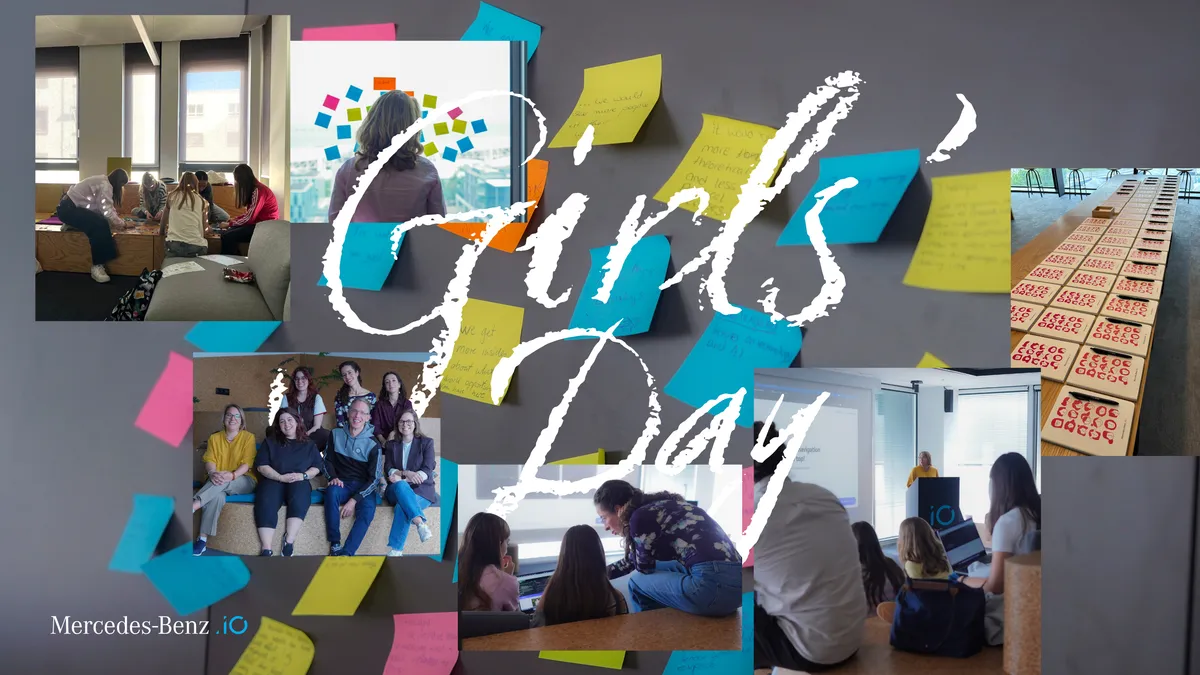
Girls' Day 2026: Building confidence, curiosity and careers from an early age
On April 23rd, Mercedes‑Benz.io welcomed students into its Lisbon, Braga and Stuttgart offices for Girls’ Day 2026, a day dedicated to opening doors, sparking curiosity and challenging stereotypes around careers in technology.
We heard from some MB.ioneers that brought life to this initiative, Alexandra Teixeira, Filomena Cardoso, Giorgia D’Innocenzo, Inês Fonseca and Sofia Hinckel Dias in Lisbon, Khrystyna Dratovana, João Oliveira, Sarah Cunha and Diana Magalhães in Braga, and Michelle Kaercher, Stefan Reith and Eduarda Cruz in Stuttgart. Coming from different roles and backgrounds, they shared their expertise and also their personal stories, doubts and lessons learned along the way.
Girls’ Day is an initiative promoted by the German government aimed at encouraging young girls to explore mainly STEM areas where women are still underrepresented, including technology, engineering and digital roles. At Mercedes‑Benz.io, this aligns naturally with how we work: in multidisciplinary teams, with diverse perspectives, and with the belief that talent has no gender.
What unfolded across these locations was a day full of hands‑on learning, honest conversations and moments that stayed with us long after the workshops ended.
Contents
The power of small moments
While the day was carefully structured, many of the most meaningful moments were unexpected.
In Lisbon, during a retrospective exercise, Alexandra noticed how naturally the girls stepped into a space that often feels uncomfortable even for adults: giving feedback. Instead of hesitating, they shared their thoughts openly, placing post‑its, exchanging ideas and reflecting on what they had learned. It was a reminder that when the right environment is created, confidence can emerge quickly and that psychological safety is something we should nurture from an early age.
Across locations, others observed similar signals of impact. In Stuttgart, Stefan saw girls writing down the names of design tools and creating CodePen accounts so they could continue experimenting at home. In Braga, Khrystyna recalls a moment during the retrospective that captured the essence of the day: a girl explaining that she hadn’t realised how many different roles exist in tech and that coding suddenly felt far less intimidating.
These moments have deeper meaning when we understand how perceptions can actually change.
When curiosity turned into engagement
As the workshops moved from introductions into practical exercises, the energy in the rooms changed.
One of the clearest turning points came during an agility exercise, where the girls had to rethink their approach and collaborate across teams. Alexandra and Inês (drivers in Lisbon) both noticed how quickly communication increased. The girls began asking more questions, supporting one another and adapting their strategies together.
In Lisbon, Sofia also saw engagement peak during the frontend workshop, when the girls started customising the websites they were building. Changing colours, adding buttons and writing their own content gave them a sense of ownership, transforming the exercise from a task into a creative outlet.
That same curiosity led some to go even further. Giorgia recalls how one group went beyond the planned scope and started building their own mini web app. For Filomena, what stood out the most was not just the technical output, but how genuinely invested the girls were in understanding the design process and solving the problem thoughtfully.
Challenging expectations: theirs and ours
Many MB.ioneers came into the day with assumptions about how much the girls might already know. Those assumptions didn’t last long. Across all offices, the level of digital familiarity, curiosity and critical thinking surprised the facilitators. The girls asked thoughtful questions, connected ideas quickly and followed complex processes with ease.
In Braga, Khrystyna was struck by how insightful their questions were, often going beyond what was expected for their age. In Lisbon, Filomena observed how naturally they engaged with creative problem‑solving, while Sofia noted both their technical confidence and their enthusiasm for learning more.
Even moments of humour, like Stefan noticing how casually they called each other “bro”, highlighted something important: these girls are already navigating digital spaces with confidence. What they need is encouragement, visibility and reassurance that they belong.
For Giorgia, one specific comment changed everything, when a student shared that she felt less stressed about her future, making the impact tangible.
Why we said yes
Every MB.ioneer had their own reason for participating, but many revolved around being the person they once needed.
For Michelle, Girls’ Day was a chance to demystify education and work life. As a student, she would have appreciated hearing that university isn’t as intimidating as it’s often made out to be, and that there are many paths into a career.
Others were driven by the importance of representation. Filomena highlighted how seeing people like yourself in a role makes it easier to imagine being there one day. Giorgia echoed this, stressing that experiences like Girls’ Day can shape beliefs long before career decisions are made.
For Inês and Sofia, the motivation also came from learning in return, gaining new perspectives, understanding how the next generation sees the world and reflecting on how we, as professionals, can contribute meaningfully.
What we hope the girls took home
Across all answers, a few core messages appeared again and again. That careers are not defined by gender, tech is more than just coding and that there is no single, irreversible path.
From Stefan’s belief that passion should always come first, to Alexandra’s hope that the girls felt encouraged to choose freely, the intention was clear: to leave them with confidence.
Sofia summed it up as a sense of endless possibilities, knowing that people from many backgrounds find their way into tech, often by simply taking the first step.
What “inclusion starts early” looks like in practice
Inclusion is not an abstract concept. It means giving access to knowledge early, challenging outdated gender roles and embedding inclusive thinking into how we teach, design and build.
As Filomena explained from a product and UX perspective, inclusion works best when it’s part of the foundation and we can do that through education, representation or hands‑on experience. The outcome is more evident than ever; the earlier we normalise diversity, the more natural it becomes.
Thinking of volunteering next year?
The advice from those involved is unanimous: go for it. From the joy of seeing excitement and confidence grow, to the personal reflection that comes from sharing your own journey, Girls’ Day gives back more than it takes. By opening our doors for one day, we don’t just inspire future generations, we remind ourselves why inclusion, curiosity and diversity matter every day.
Related articles

Melanie Pillkahn
Two Companies, One Team: What ODP Has Taught Me About Collaboration
When people hear about the One Developer Portal (ODP), the conversation usually starts with the placement. But for me, one of the most interesting parts of the journey has been something else entirely: the people.
Oct 9, 2026
Carolina Andrade
Diversity Diaries: Why Spaces Like She's Mercedes Still Matter
Do we still need initiatives like She's Mercedes?
Oct 6, 2026

Vaibhav Khatri, Nikolaus Kober
5 Skills Every AI Engineer Needs Today (And Why the Role Matters More Than Ever)
From system design and evaluation to Responsible AI and observability, here's what it takes to build AI that works in the real world.
Sep 29, 2026