
Inside Tech: When Is it a bot? is no longer the right question
Technology rarely evolves around one question at a time. Performance can quickly become a conversation about security, customer experience or, increasingly, AI.
Inside Tech is a series where Mercedes-Benz.io experts share their perspective on the technologies they work with and the questions shaping their fields.
In this edition, Igor Ramos explores how the role of Content Delivery Networks is changing as bots and AI agents become a bigger part of internet traffic, challenging one of the simplest assumptions in web security: that recognising a bot tells us whether an interaction is good or bad.

Igor Ramos
Contents
For a long time, the basic job of a Content Delivery Network, or CDN, was relatively easy to explain: bring content closer to users so websites load faster and infrastructure works more efficiently. That’s still important. But it’s no longer the whole story.
As CDNs have evolved, security has become an increasingly significant part of their role. Today, the same technologies that help us deliver digital experiences efficiently can also help protect them from suspicious traffic, automated attacks and threats targeting APIs. In my work at Mercedes-Benz.io, that evolution has made one thing particularly clear: understanding where traffic comes from is no longer enough. We increasingly need to understand what that traffic is trying to do.
Artificial Intelligence (AI) makes that distinction even more important.
A bot can be good and bad
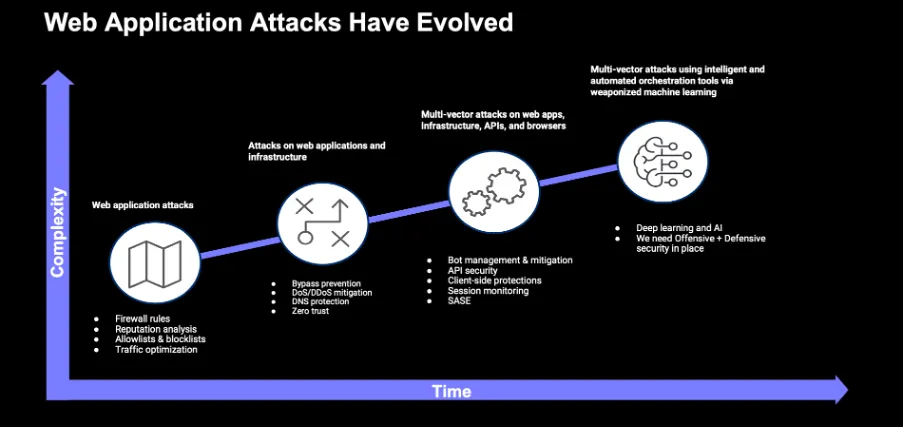
Bot traffic isn’t black and white anymore. People increasingly use bots and AI agents to perform tasks on their behalf, making some automated traffic a perfectly legitimate part of the customer journey. But bots can also be used to attack websites, and similar technology can behave very differently depending on who is using it and why.
For security teams, this means the old approach of recognising a bot and automatically treating it as unwanted traffic is becoming less useful. We need smarter rules and a better understanding of behaviour and intent before deciding how an interaction should be handled.
I find this shift particularly interesting because it changes the fundamental question. Instead of only asking “Is this a bot?”, we increasingly need to ask “Is this an interaction we actually want?”.
It’s a small change in wording, but a much bigger change in how we think about automated traffic.
AI is making reaction time shorter
AI is also accelerating how quickly the security landscape changes. Vulnerabilities can be identified, shared and exploited faster, which means the time available to react is getting shorter. In situations where security teams once had days to understand a vulnerability and respond, the relevant window can now be measured in hours or less.
Fortunately, AI can also support the defensive side. It can learn from attack patterns and suggest new protection rules, giving security teams more information and helping them respond faster. But I don’t see that as a reason to remove people from the process.
Human judgement remains important. In the setup I work with, proposed rules can be generated using AI, but security experts remain involved in validating those recommendations before they are applied. For me, that’s where the combination becomes valuable: automation provides speed, while people provide oversight and context.
What happens when the visitor is an AI agent?
Perhaps the question I’m most interested in now is what happens after we’ve decided that an automated interaction is legitimate.
If an AI agent is acting on behalf of a person, should we give that agent exactly the same digital experience we would give a person?
Probably not.
A website designed for people contains images, scripts and interactive elements that create the experience we see in a browser. An AI agent may not need all of those elements. What matters is whether it can access the right information to fulfil the task the person behind it has requested.
This creates an interesting opportunity. If we can understand what kind of visitor we’re serving, we can potentially provide the right amount of information in the most useful form. For an agent, that could mean delivering less data while still giving it the content it actually needs. From an infrastructure perspective, that’s more efficient. From a customer perspective, the agent still has access to the information required to provide a useful result.
And this becomes more relevant as agents take on bigger parts of the digital journey. We are moving from scenarios where an agent simply helps with an initial search towards situations where people may ask agents to research options or perform additional tasks on their behalf. That means digital experiences increasingly need to consider both people interacting directly with a website and agents acting on behalf of those people.
The next digital journey
This is the development I’m personally most interested in seeing evolve. How do we create the right journey for a human visitor and the right journey for an AI agent without treating them the same way.
Serving an agent with exactly what it needs could improve efficiency by reducing the amount of unnecessary content we deliver. More importantly, though, if that agent is acting on behalf of a real person, the quality of the information we provide still becomes part of that person’s experience with the brand.
For me, that’s why performance, security and customer experience are becoming increasingly connected. We can’t maximise one simply by ignoring the others. Blocking everything may appear secure, but it can also block legitimate interactions. Delivering everything may provide a rich experience for a person, but it may be unnecessary for an agent. The challenge is understanding the traffic well enough to make the right decision.
And that balance isn’t something we solve once. It changes as technology, threats and customer behaviours change.
The internet has always evolved around how people use it. What’s different now is that increasingly, there may be an agent standing between the person and the digital experience. For those of us building and protecting that experience, understanding who the interaction ultimately serves may become much more important than simply identifying whether the visitor is human or a bot.
Related articles

Joana Paiva, Nivaldo Caires
AI Talks, Zadar Walks and Crystal Waters
Last month, 10 Quality Assurance Engineers (QA) and a Frontend Engineer embarked on a journey to Zadar, Croatia, for the annual Infobip Conference.
Nov 17, 2026
Jens Wallner
How Information Architecture Creates Shared Understanding
In this edition of Tecknowledgy, Jens Wallner, Information Architect at Mercedes-Benz.io, shares why alignment across Product, Design, Engineering and Business starts with something deceptively simple: being clear about
Nov 13, 2026
João Almeida
After the Filter Menu: Four things that actually changed, and one slide I break on purpose
Over the last few months, I have given more or less the same presentation several times. Students, meetups, groups passing through our Lisbon office. Somebody has to explain how AI and data actually show up inside a digi
Nov 6, 2026