Scalability Under Test: What Load Testing Can’t Miss in 2025
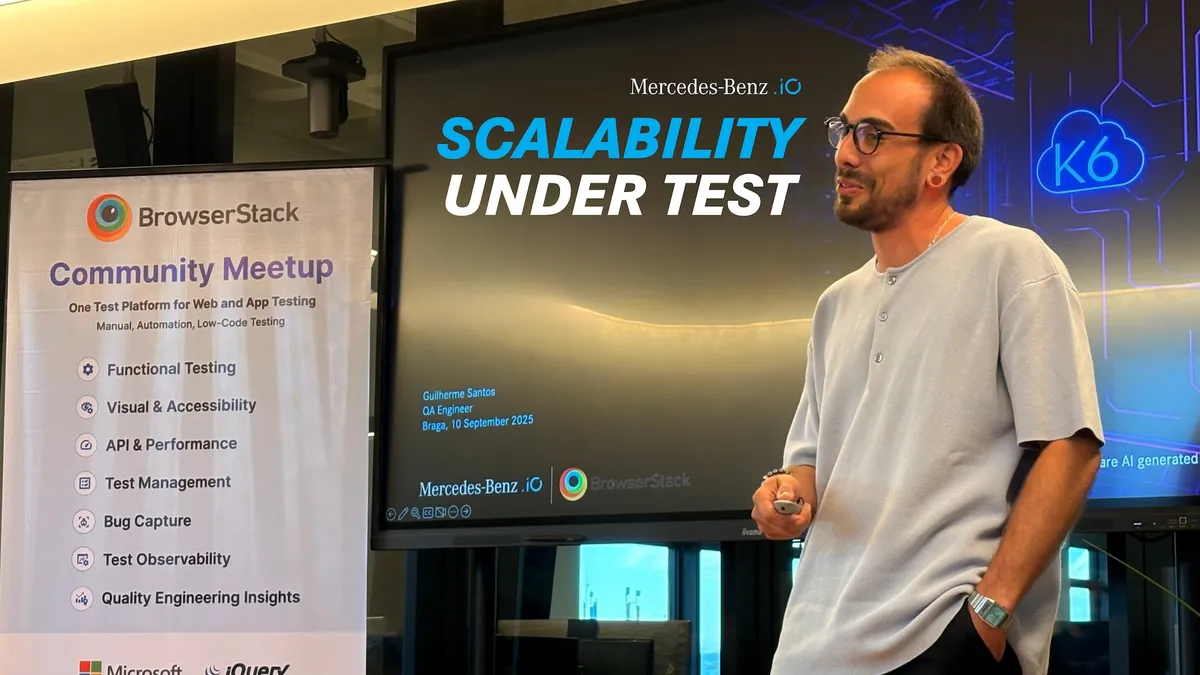
On September 10th, 2025, Guilherme Santos had the chance to take the stage at the BrowserStack QA Meetup, hosted at the Mercedes-Benz.io office in Braga, to talk about something every tech team faces sooner or later: performance under pressure.
His session, titled Scalability Under Test: Effective Load Testing with k6, wasn’t just about tools. It was a deep dive into why load testing still matters, especially in the era of microservices, real-time experiences, and ever-higher user expectations.
Contents
Why Load Testing Still Matters
From ticketing systems crashing on concert sale days to e-commerce apps going down on Black Friday, performance failures are still making headlines, and they’re not always caused by bad code. Often, it’s about untested capacity, scaling issues, or hidden bottlenecks in complex, distributed systems.
That’s why Guilherme kicked off with a reminder: “Performance isn’t a final step; it’s a mindset that needs to live in our workflows.”
Meet k6: Load Testing for the Modern Dev
During the session, Guilherme introduced k6, a developer-first, open-source tool designed to bring load testing into the heart of modern pipelines. Here’s why it stood out:
-
Scripted in JavaScript/TypeScript (easy onboarding for devs)
-
Multiple load models: spike, stress, soak, breakpoint…
-
Built-in thresholds and pass/fail signals
-
Seamless observability (Grafana and others)
-
Works natively with CI/CD pipelines (GitHub Actions, GitLab, Jenkins…)
Why CI/CD Needs Performance Too
One of the session’s key themes was how naturally k6 fits into CI/CD workflows, something Guilherme called “a shift-left superpower”:
-
Use smoke tests on pull requests
-
Run nightly stress tests
-
Perform soak tests before production releases
-
Automate alerts and dashboards for continuous visibility
This isn’t just performance testing, it’s continuous performance confidence.
Live Demo Highlights
Guilherme walked the audience through real-life code examples from an open-source repository, showing:
-
How to gradually ramp up load
-
How to define thresholds tied to business SLAs
-
How to pair k6 with observability tools
-
How to share results with teams through automated dashboards
5 Takeaways from the Talk
-
Start small: don’t simulate 10k users on day one
-
Define thresholds based on user expectations, not guesswork
-
Investigate performance early to avoid production surprises
-
Automate reporting and CI/CD integration
-
Remember: performance testing is a practice, not a one-off
Why It Mattered
This wasn’t just a tech talk; it was a reminder that performance testing deserves a seat at the product table.
For Guilherme, speaking at the meetup was a chance to share hard-earned lessons, open up conversations around sustainable testing, and show that load testing is evolving and so should we. In a world where user trust depends on speed and stability, load testing isn’t a blocker, It’s an enabler.
Related articles

André Félix
From Cool Demos to Production Reality: Insights from the April Lisbon JUG Java Meetup
At Mercedes-Benz.io, we actively engage with local and international tech communities to explore how emerging technologies can be applied responsibly in enterprise environments. In April, we were proud to take part in th
May 19, 2026

Romina Muenchow-Centili
AI in Service Management: Driving Efficiency, Quality and Impact
Artificial Intelligence (AI) is no longer a distant promise in Service Management, it is already reshaping how teams work, think and deliver value. In this edition of Technkowledgy, Romina Muenchow-Centili, Service Manag
May 12, 2026

João Almeida
Behind the Engine: How Carl.AI Scales Knowledge Access at Mercedes-Benz.io
At Mercedes-Benz.io, not every product we build is visible to customers. Some of the most important ones work quietly behind the scenes, shaping how teams collaborate, share knowledge, and build digital products more eff
Apr 28, 2026