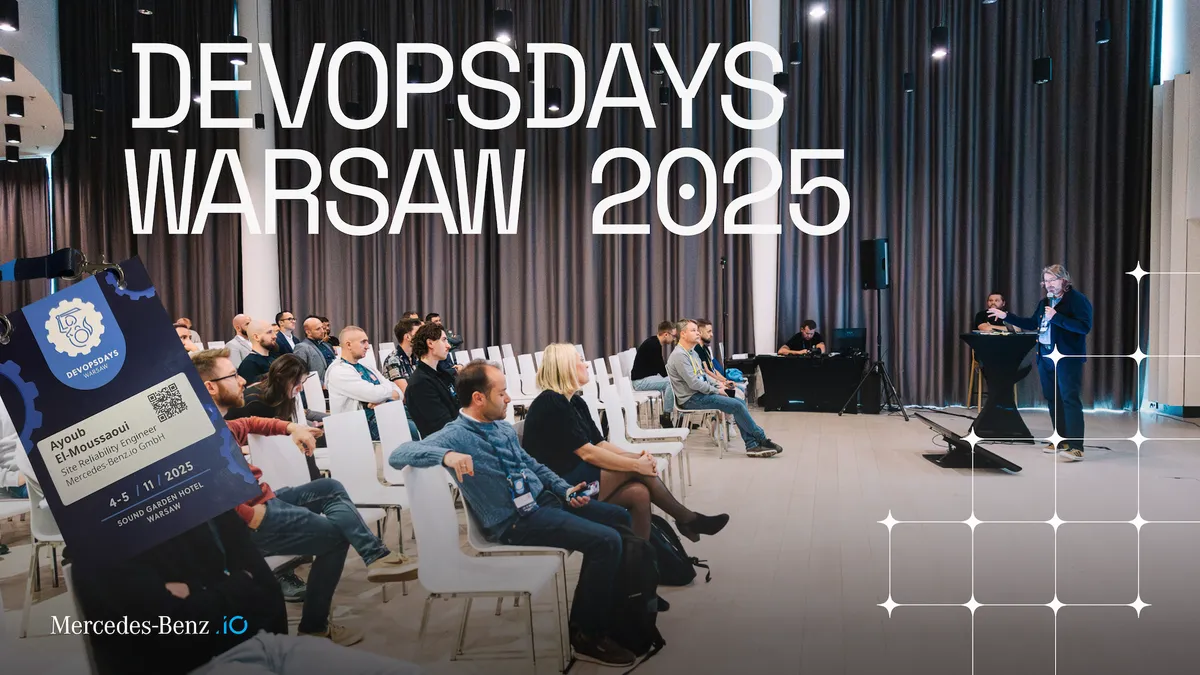
Scaling DevOps with Confidence: Key Takeaways from DevOpsDays Warsaw 2025
What does it take to build platforms that are fast, secure, and resilient at scale? At DevOpsDays Warsaw 2025, the answer was clear: standardisation, automation, and AI-driven support are no longer “nice-to-haves.” They’re the new baseline.
Representing Mercedes-Benz.io on the ground was Ayoub El-Moussaoui, Site Reliability Engineer (SRE), who attended the event in Warsaw to gather insights and connect with peers tackling the same complex challenges. “It wasn’t just about tooling or frameworks, it was about culture, consistency, and reducing friction for teams.”, and here’s what stood out from the conference:
Contents
GitOps, But Make It Strict
The dominant message was that GitOps isn’t just for Kubernetes anymore. The practice of managing everything as code, infrastructures, services, and environments, is expanding into every corner of DevOps, but with scale comes new tension.
A growing number of teams are adopting a strict GitOps workflow, preventing direct access to production environments. Changes follow a path from the developer, through the service repository, then the GitOps repository and engine, before reaching production. While emergency access is still possible, it remains an exception.
The main challenge isn’t technology, but people, processes, and fear. Teams are responding by investing in education, clear workflows, and building a GitOps culture from the ground up.
Designing Golden Paths for Delivery at Scale
One theme Ayoub kept encountering: Golden Paths. These are curated, best-practice workflows that help dev teams move faster without reinventing the wheel.
When teams are aligned by design, not by enforcement, you reduce decision fatigue and increase quality by default,” he said. “It’s about balancing flexibility with standardisation.
Golden Paths are not intended to restrict creative approaches; rather, they are designed to facilitate best practices by default and leverage consistency as a means of driving efficiency.
When Incidents Strike, AI Is the First Responder
One of the most future-facing talks came from Adidas, where they’re using AI agents as real-time support for SRE teams. During an incident, an internal AI chatbot works like a “triage nurse”: prioritising, classifying, and routing issues based on logs, traffic, and observability data.
The results are clear: quicker resolution, fewer misrouted tickets, and increased engineer satisfaction. The takeaway for Ayoub really complements this outcome: “AI isn’t there to replace engineers. It’s there to reduce noise and cognitive overload, so we can focus on what actually needs fixing.”
Tools That Made an Impact
Ayoub also came back with a shortlist of tools that sparked conversation:
Flox – Nix-based dev environments as code, improving dev consistency.
Mermaid – Diagramming as code, directly in Git repos or markdown.
k6 – Open-source load testing, used for automated API stress testing.
C4 Model – Visualise systems at every layer: Context, Container, Component, Code.
Docling (IBM) – AI-powered document processing for automating unstructured knowledge.
Cagent – Docker-native AI agent framework, integrating intelligence into container workflows.
None of these were pitched as magic fixes, but as part of the bigger puzzle of building secure, scalable, developer-friendly systems.
What This Means for Us
If there’s a single thread through every talk, it’s this: Developer Experience and Platform Engineering are merging.
There’s no such thing as “just building systems”, as now teams are actively interacting with those systems. Whether by implementing advanced incident management tools, establishing standardized delivery processes, or enhancing onboarding procedures, the objective remains clear: to minimize obstacles and optimize operational efficiency.
As Ayoub reflected: “The best platforms are the ones you barely notice. They just work and they let you focus on building.”
And as teams across Mercedes-Benz.io continue scaling platforms, migrating services, and improving our own delivery practices, conferences like these are more than inspiration, they’re checkpoints for how far we’ve come, and where we need to go next.
Related articles
André Félix
From Cool Demos to Production Reality: Insights from the April Lisbon JUG Java Meetup
At Mercedes-Benz.io, we actively engage with local and international tech communities to explore how emerging technologies can be applied responsibly in enterprise environments. In April, we were proud to take part in th
May 19, 2026
Romina Muenchow-Centili
AI in Service Management: Driving Efficiency, Quality and Impact
Artificial Intelligence (AI) is no longer a distant promise in Service Management, it is already reshaping how teams work, think and deliver value. In this edition of Technkowledgy, Romina Muenchow-Centili, Service Manag
May 12, 2026
João Almeida
Behind the Engine: How Carl.AI Scales Knowledge Access at Mercedes-Benz.io
At Mercedes-Benz.io, not every product we build is visible to customers. Some of the most important ones work quietly behind the scenes, shaping how teams collaborate, share knowledge, and build digital products more eff
Apr 28, 2026