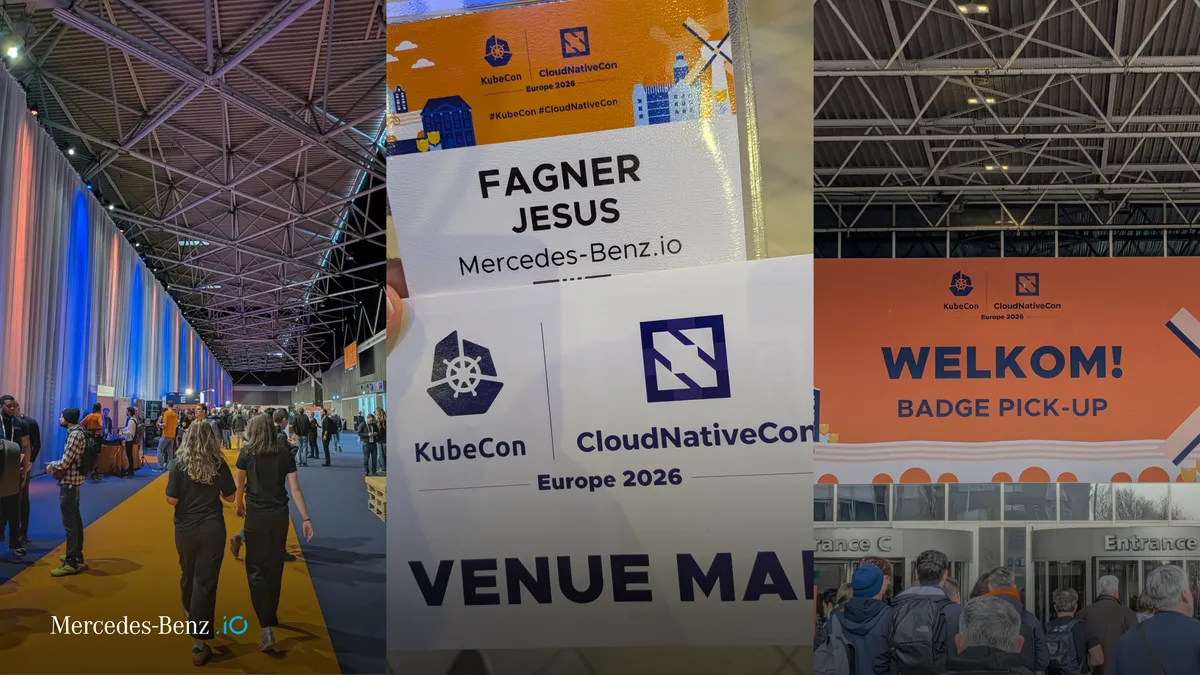
KubeCon + CloudNativeCon: How Platform Engineering Is Shifting from Tools to Intent
KubeCon + CloudNativeCon is never just about Kubernetes, but more about where the cloud‑native ecosystem is heading next, technically, organisationally, and culturally. This year, Mercedes‑Benz.io was represented by several MB.ioneers, including Fagner Jesus and Flávio Moringa, who returned with fresh perspectives on platform engineering, AI‑driven operations and what it really means to build platforms that deliver value.
The main takeaway is that cloud-native platforms are evolving beyond human use and are now increasingly tailored for machines and automated agents as well. But let’s dive in!
Contents
Re‑centring Platform Engineering Around “Why”
For Fagner, one of the most impactful moments came from a reminder of purpose.
A keynote by Abby Banser brought up something fundamental: platform teams already have powerful technologies and deep expertise, but without a clear why, platforms risk becoming complex systems that serve themselves rather than their users.
The message was sound and clear: platform engineering exists to help customers build value, not to assemble tools for their own sake.
This perspective was reinforced by a panel discussion on how platforms can support junior engineers. Rather than replacing engineers with automation or AI, the perspective was on empowerment with guardrails, using intelligent systems to raise the baseline of quality while still enabling learning, autonomy and craftsmanship.
Together, these sessions contextualised platform engineering as a discipline centred on capability delivery, not infrastructure ownership.
The Rise of Agent‑Driven Cloud‑Native Systems
Flávio’s perspective shift emerged from a recurring pattern across the entire conference: AI agents are becoming first‑class citizens in cloud‑native systems.
From main stage keynotes to deep‑dive technical sessions, the same idea surfaced again and again, with talks on agentic systems, AI‑driven troubleshooting and automated remediation showing a clear evolution that platforms are moving from passive observability to active participation in operations.
Instead of humans manually correlating metrics, logs and traces at 3am, emerging systems can now:
- detect degraded workloads
- correlate signals across telemetry
- investigate potential causes
- trigger or propose remediation actions
What made this insight click was its consistency. Whether viewed through the lens of platform engineering, GitOps or operations, the direction was unmistakable: cloud‑native systems are becoming increasingly agent‑driven rather than human‑driven.
Kubernetes is no longer just a platform we operate; it is becoming a runtime where automated actors collaborate alongside humans.
When the Cloud‑Native Brain Clicks
For both MB.ioneers, KubeCon highlighted a deeper shift in how platforms are consumed.
Flávio described a pivotal realisation: modern platforms now have two types of users: 1) Humans, who need great developer experience, and 2) Automated agents, which need structured, machine‑consumable context.
This reframes many familiar platform building blocks. On the one hand, service catalogues are no longer just developer portals: they encode ownership, dependencies and system boundaries in a structured way. On the other hand, observability data is no longer just dashboards: it becomes input for automated reasoning and decision‑making.
The reason AI‑driven operations are now viable isn’t only better models, but mainly because platforms have matured to the point where they emit consistent, correlated and machine‑readable signals.
In that sense, today’s AI‑assisted operations are an evolution of trends already underway, from autonomous infrastructure optimisation to increasingly self‑healing systems.
Tools, Practices and Patterns Worth Exploring
KubeCon + CloudNativeCon also surfaced concrete ideas that resonate strongly with the work already happening at Mercedes‑Benz.io.
Smarter Kubernetes Control Planes
On the technical side, upcoming Kubernetes features such as the EvictionRequest API point towards more deliberate and controllable node lifecycle management, a critical capability for large, dynamic fleets.
The widespread adoption of tools like Argo CD, Kyverno and Backstage reinforced their role as foundational building blocks for modern platforms that balance autonomy with governance.
FinOps Meets AI
Cost and resource management featured prominently across the conference. FinOps is evolving from reporting into intelligent optimisation, increasingly powered by AI to correlate usage, performance and business value.
This aligns with a broader trend: platform teams are becoming stewards not just of reliability, but of sustainable efficiency.
Platforms as Enablers, Not Gatekeepers
From an organisational perspective, Fagner highlighted how encouraging it was to see familiar practices validated by the wider community:
- Hackathons to drive experimentation
- Communities of Practice to share knowledge
- Golden Paths to guide teams from idea to production and through day‑two operations
These patterns foster alignment without enforcing rigidity, helping teams move faster while maintaining quality.
GitOps Beyond Delivery
One particularly strong theme was the evolution of GitOps.
What started as a deployment model is now expanding into closed‑loop systems that include detection of drift or degradation, automated or guided remediation, and policy‑driven safety boundaries.
Observability platforms are evolving into systems that not only display data but also initiate actions in response to it.
As automation increases, governance becomes even more critical where policies are no longer just compliance artefacts; they are the guardrails that make safe automation possible.
Designing Platforms for Humans and Machines
For Fagner, building cloud‑native platforms means moving beyond assembling tools and instead delivering capabilities that genuinely help customers, including the shift from “infrastructure for apps” to infrastructure for AI systems.
For Flávio, it means designing platforms that are:
…not only usable by humans, but understandable and actionable by automated agents.
Catalogues, observability, deployment pipelines and policies all need to be structured, consistent and safe to act on. The next phase of platform engineering is less about adding layers, and more about making existing ones legible, to people and to machines alike.
Beyond the technology, KubeCon + CloudNativeCon was also a reminder of the human side of engineering. Conferences are learning moments, but they are also bonding moments, opportunities to share ideas, challenge assumptions and build relationships that last long after the talks end.
Related articles
Pedro Henriques, Ricardo Mano, +1
KotlinConf 2026: When Type Safety Meets Intelligent Systems
What happens when a language built on clarity and reliability meets a setting driven by AI and speed?
Jun 23, 2026
Karla Silva
Selenium Conference 2026: AI, BiDi, and the Future of Test Automation
From May 6 to 8, the Selenium and Appium Conference took place in Valencia, bringing together the global automation community for three days of technical discussions and knowledge sharing. Built by the community and for
Jun 12, 2026

Alexandra Teixeira
The Art of the Juggle: Balancing Business, Team and Ownership as a Product Owner
Being a Product Owner (PO) often feels like standing at the centre of multiple worlds at once. There's the business, moving fast and reacting to market pressure; and also, the team, deeply invested in the product, armed
Jun 9, 2026