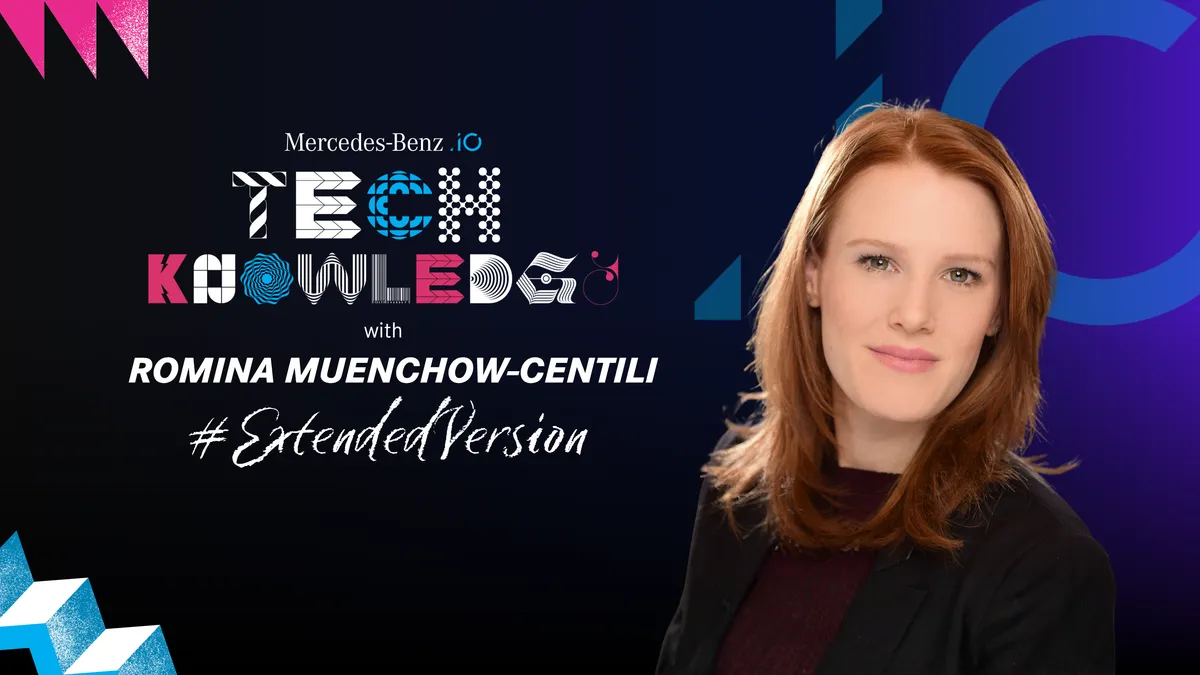
AI in Service Management: Driving Efficiency, Quality and Impact
Artificial Intelligence (AI) is no longer a distant promise in Service Management, it is already reshaping how teams work, think and deliver value. In this edition of Technkowledgy, Romina Muenchow-Centili, Service Manager at Mercedes‑Benz.io and AI Ambassador, shows how AI is influencing her daily work, improving service quality, and redefining the balance between human expertise and intelligent support.
Contents
From Manual Effort to Strategic Focus
For Romina, AI has had a noticeable impact on her day‑to‑day work as a Service Manager. It took over many smaller and manual tasks, allowing her to focus on responsibilities that require deeper thinking and experience, such as research, translations, documentation and standardisation, traditionally time‑consuming and mentally demanding, are now significantly faster and more efficient.
This move has a direct effect on quality and impact. Instead of spending energy on repetitive tasks, Romina can dedicate more attention to complex service management challenges, long‑term improvements and strategic initiatives.
Improving Core Service Management Practices with AI
Service Management relies heavily on structured frameworks and standardised processes, such as ITIL (Information Technology Infrastructure Library). While these frameworks provide clarity and consistency, they also involve a large amount of manual effort.
According to Romina, AI is already simplifying and accelerating several key areas:
- Knowledge Management: AI helps translate concepts and processes into structured, standardised documentation. It can suggest relevant knowledge base articles during ticket creation and identify gaps in existing content.
- Problem Management: By analysing support tickets and recurring issues, AI can detect patterns, suggest potential root causes and highlight routing inefficiencies that might otherwise go unnoticed.
- Incident and Reporting Processes: AI supports faster incident handling, improves consistency across services and reduces manual workload for Service Managers and support roles.
Beyond these areas, Romina also sees strong potential in Major Incident Management and proactive service monitoring, where AI‑driven insights can help teams anticipate issues instead of only reacting to them.
The outcome is improved speed, service quality, and sustainability for Service Management teams.
AI and the Future of Service Management at Mercedes‑Benz.io
Looking ahead, Romina is confident that AI will play a central role in shaping Service Management at Mercedes‑Benz.io as it is already being used in internal tools for root cause analysis, problem management and KPI evaluation. Building on this foundation, the AI Ambassador Programme at Mercedes‑Benz.io was launched to encourage AI adoption across the organisation and to empower colleagues to use AI confidently in their daily work.
The vision is a future where AI is not seen as an “extra tool”, but as a natural and trusted part of how teams work. For Service Management, this means less repetitive manual work, faster and more consistent outcomes, and improved quality of analysis and decision‑making. When applied carefully, AI can significantly boost personal productivity and enhance the value of an organisation.
Finding the Right Balance Between Human Expertise and AI
One of the most important topics Romina highlights is the balance between human responsibility and AI support.
As AI capabilities grow, it can be tempting to assume that “AI will handle it”. However, this approach carries certain risks. While artificial intelligence serves as a valuable support resource, ultimate responsibility and decision-making must consistently be retained by human individuals.
Romina emphasises that AI depends heavily on high‑quality input where clear objectives, precise instructions and domain‑specific knowledge are essential because, ultimately, the quality of the output directly reflects the quality of the input.
Investing time in well‑structured prompts, as well as in advanced features such as skills and agents, is where real value is created where AI becomes an enhancement.
Advice for Service Managers Starting Their AI Journey
For Service Managers who are just beginning to explore AI, Romina’s advice is practical and encouraging. First and foremost: stay open‑minded. Early challenges and setbacks are part of the learning process, and practice is crucial. We should see AI adoption as a journey, and not a one‑time change.
She also recommends starting with concrete use cases by asking simple questions like “Where can AI support me most effectively in my daily work?” we make the entry easier and increase the likelihood of long‑term adoption.
Finally, continuous learning is key. Training opportunities such as courses, webinars and learning about AI skills and agents help build confidence and support the mindset shift required to work effectively with new technologies.
AI as a Natural Part of Service Management
Romina’s perspective highlights that AI is meant to empower Service Managers, not replace them. It reduces manual work, improves consistency, and provides valuable insights, supporting a shift toward proactive, strategic, and human-centred service management at Mercedes‑Benz.io. Programs like the AI Ambassador Programme demonstrate how this change relies on people learning and integrating AI into daily tasks.
Related articles
Pedro Henriques, Ricardo Mano, +1
KotlinConf 2026: When Type Safety Meets Intelligent Systems
What happens when a language built on clarity and reliability meets a setting driven by AI and speed?
Jun 23, 2026
Karla Silva
Selenium Conference 2026: AI, BiDi, and the Future of Test Automation
From May 6 to 8, the Selenium and Appium Conference took place in Valencia, bringing together the global automation community for three days of technical discussions and knowledge sharing. Built by the community and for
Jun 12, 2026

Alexandra Teixeira
The Art of the Juggle: Balancing Business, Team and Ownership as a Product Owner
Being a Product Owner (PO) often feels like standing at the centre of multiple worlds at once. There's the business, moving fast and reacting to market pressure; and also, the team, deeply invested in the product, armed
Jun 9, 2026