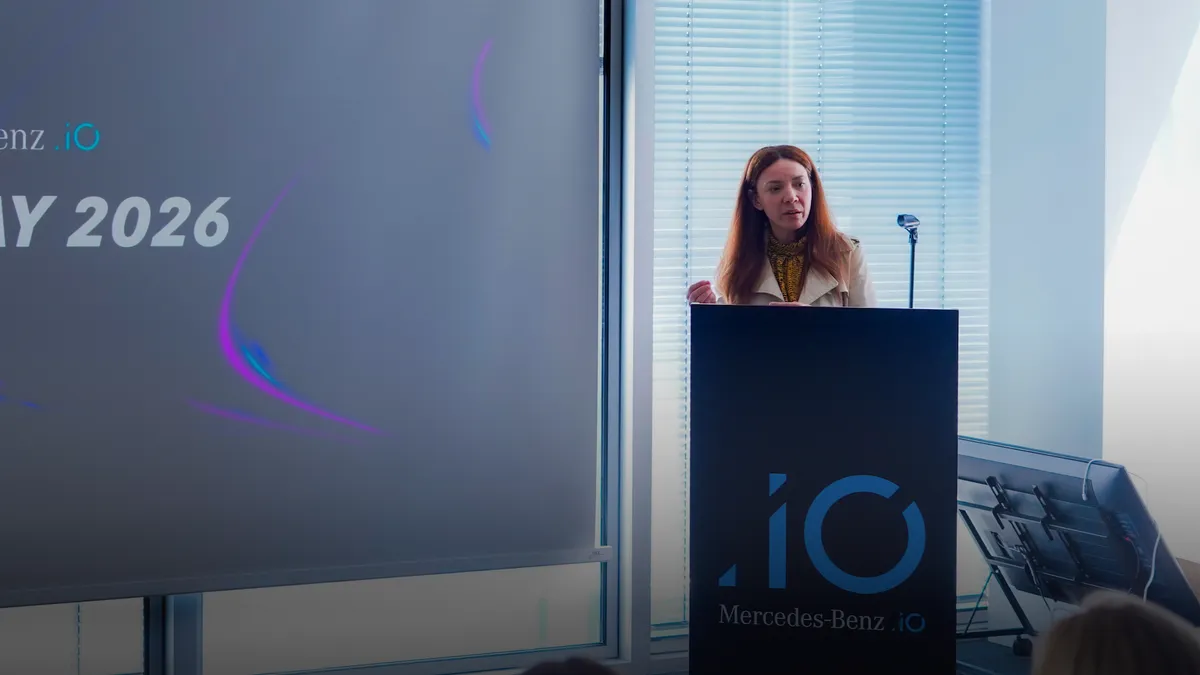
Changing Gears: Daniela Journey from Psychology to Tech
Daniela Santos started her career in psychology. From the very first class, that field felt like a natural fit, where psychology offered what she was looking for at the time: logic, curiosity and a structured way to understand how people think, behave and make decisions.
Daniela’s studies were highly scientific. Alongside behavioural theory, she covered neuroscience, anatomy, statistics, mathematics and research methods, learning to formulate hypotheses, analyse data and draw evidence‑based conclusions. At the time, her path seemed set: focusing on people, behaviour and decision‑making through a psychological lens. Even then, technology was never far from her mind.
Contents
A parallel interest that never disappeared
Technology had always been part of Daniela’s life as she grew up with a tech-oriented father, meaning computers and digital tools were familiar from an early age. While it wasn’t her chosen profession at first, she constantly followed tech trends, explored new tools and enjoyed understanding how systems worked, purely out of curiosity.
At that point, however, technology remained a personal interest rather than a professional ambition as psychology was her chosen path, and she was fully committed to it.
The real shift came with Daniela’s first role as a Product Manager at another company. This position became the bridge between her psychology background and the technology world. In this role, she was exposed to system architecture, product logic and the behind‑the‑scenes structure of digital products. For the first time, technology stopped being something she simply used or explored casually, it became something she could shape.
A crucial factor in this transition was her manager at the time, who actively invested in mentoring and development. He shared technical knowledge, recommended courses, explained systems in depth and, most importantly, trusted Daniela with responsibility early on.
“That trust made me realise I was capable of much more than I initially thought,” she explains.
The moment technology became a career choice
One project marked a turning point: building a back‑office tool in Visual Basic. It was Daniela’s first hands‑on technical project, and it changed how she saw herself professionally. Until then, her identity was still closely tied to psychology. After that project, technology became a real career option.
“I realised that I didn’t just like technology as a hobby, I loved the logic, the structure and the problem‑solving behind it,” she says.
This wasn’t a rejection of psychology, but an evolution after Daniela began to see how her background could actively strengthen her work in tech rather than limit it.
The challenge of changing professional identity
Moving from psychology into tech was not without obstacles. One of the biggest challenges was being taken seriously. Particularly, because there is still a common misconception that psychology is purely emotional or theoretical. Daniela often felt the need to prove the analytical and scientific value of her background, especially in technical environments.
Over time, that perception shifted and as she gained experience, it became clear that psychology had equipped her with skills that were not only transferable but essential in tech roles: research, data analysis, communication, leadership and customer understanding.
“In many ways, understanding a digital system isn’t so different from understanding the human brain,” she notes. “Both are complex systems made up of patterns and connections.”
As Daniela continued to evolve professionally, her role expanded beyond product management. Today, she works at the intersection of business, technology and people, supporting organisations in building digital products while also driving organisational change.
Her work now includes strategy, leadership, innovation and preparing companies for AI-driven transformation, and this change reflects another role evolution, from specialist to enabler.
“I help organisations evolve,” she explains. “Not just through technology, but through collaboration, mindset and leadership.”
What excites her most is the constant challenge and learning, as each role change was driven by curiosity and the desire to grow, rather than by a predefined career plan.
Why non‑linear role changes are a strength
Daniela strongly believes that careers no longer need to follow a straight line, especially in technology.
Her transition from psychology to tech gave her a broader perspective and the ability to connect disciplines that are often kept separate. In her experience, non‑linear career paths build adaptability, creativity and stronger problem‑solving skills.
“With technology, and especially AI, reshaping how we work, roles will keep changing,” she says. “The people who adapt best are those who stay curious and keep learning.”
A message to career‑switchers and women in tech
For anyone considering a move into tech, Daniela’s journey is proof that a non‑technical background is not a disadvantage.
“You don’t need a computer science degree to work in tech,” she emphasises. “Technology needs people who understand behaviour, communication, strategy and problem‑solving.”
Her advice is simple: seek mentors, ask questions, build connections and don’t be afraid to say you don’t know. Every role change starts with curiosity and the willingness to learn.
Reflecting on what advice she would give to her younger self, it would be to trust her curiosity more and overthink less.
Her career didn’t change direction once; it grew through a series of intentional role changes. From psychologist to product manager, from product to technology leadership, each step built on the previous one. And that, she believes, is exactly how modern careers should work.
Related articles
David Afonso
Diversity Diaries: Why Pride, Visibility and Storytelling Still Matter
This Pride Month, we're opening the conversation with something simple: real stories, real voices, real impact. We sat down with David Afonso, the brain and heart behind the YOU series, the initiative that has been bring
Jun 16, 2026
Vera Cartaxo
Girls' Day 2026: Building confidence, curiosity and careers from an early age
On April 23rd, Mercedes‑Benz.io welcomed students into its Lisbon, Braga and Stuttgart offices for Girls' Day 2026, a day dedicated to opening doors, sparking curiosity and challenging stereotypes around careers in techn
May 2, 2026
Vera Cartaxo
Owning The Desk: Celebrating International Women’s Day at Mercedes-Benz.io
At first glance, a desk is just a piece of furniture. But for many of us, it’s where our worlds meet: work and home, ambition and identity, memories and dreams.
Mar 13, 2026