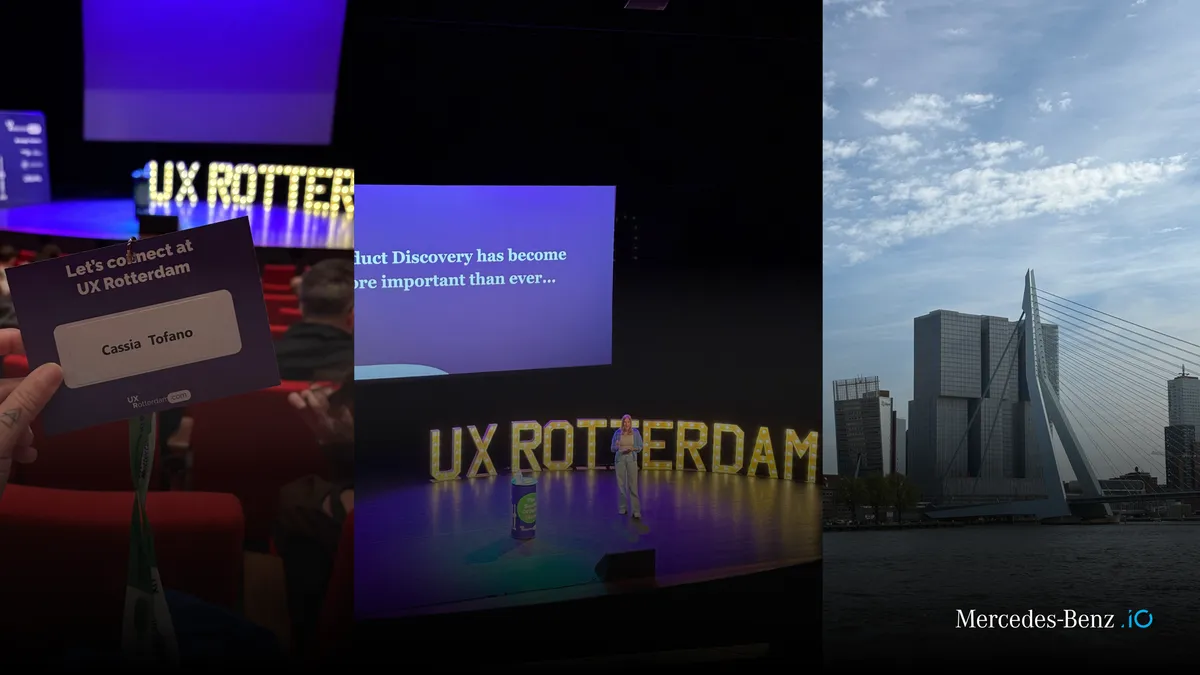
From UX Rotterdam 2026 to Mercedes-Benz.io: Reflections on AI, Strategy and the Future of User Experience
At UX Rotterdam 2026, Cassia Tofano and Rita Saraiva immersed themselves in a program rich with forward-thinking perspectives on the future of user experience. Their key takeaway: as artificial intelligence transforms design workflows, the designer’s role is not shrinking — it is actually evolving.
Contents
AI in UX: A Powerful Collaborator, Not a Replacement
A consistent theme throughout UX Rotterdam 2026 was the growing impact of AI in design and the importance of using it responsibly.
For Rita, one speaker stood out: Serena Westra, Strategic Design Leader at IKEA. Her perspective struck a careful balance between enthusiasm and critical thinking, as she said that AI was becoming an incredibly powerful tool for accelerating research, ideation, and content generation, but that it would never replace the human side of UX.
This idea crystallised during several sessions, where AI was framed as a collaborator that amplifies human expertise without substituting designers — where tools can accelerate processes, but empathy, context, and judgment remain uniquely human capabilities.
Cassia echoed this sentiment, noting how widely AI is already embedded in design practices:
AI is already part of most people’s process, which is powerful, but also risky if used without care.
For her, the critical challenge lies in avoiding over-reliance — where AI can automate parts of the design process, but it cannot replicate human empathy, nor can it fully understand the emotional context behind user needs.
Strategic Design: A Competitive Advantage in a Fast-Moving Landscape
Beyond AI, Cassia identified strategic design as a defining capability for the future of UX, especially in large organisations.
Serena Westra’s case from IKEA illustrated how strategic thinking enables teams to:
- Align user needs with business objectives
- Reduce risk in decision-making
- Drive long-term impact beyond individual features
For Cassia, this was particularly inspiring: in a scenario where everyone can quickly create solutions, being strategic becomes crucial for a good Experience Designer.
Applying the Learnings at Mercedes-Benz.io
Both Cassia and Rita reflected on how these insights could be relevant in the design field with learnings for the industry’s future.
Exploring How AI Can Support UX Workflows
Across the design lifecycle, there are indications that AI could potentially support areas such as:
- Research synthesis, by helping to structure and analyse user insights
- Prototyping, through faster generation of concepts for testing
- Content creation, as a support for UX writing
At the same time, Rita highlighted the importance of maintaining a strong human perspective, emphasising that outputs benefit from critical review to ensure quality, relevance, and empathy.
Reflecting on Principles for Responsible AI Use
As AI becomes more present in everyday work, the topic of governance is gaining relevance, and the conference pointed to elements such as:
- Ethical considerations
- Transparency in AI-generated outputs
- Accessibility and inclusivity
These aspects may serve as useful reference points for ongoing conversations around responsible AI usage, helping to balance innovation with trust and consistency.
Considering Data in Strategic Decision-Making
Cassia also emphasized the broader opportunity of strengthening how data informs product decisions, particularly when combining:
- User research insights
- Product performance data
- AI-supported analysis
This perspective underlines the potential value of using data to support more informed, user-centred, and strategically aligned decision-making, while remaining mindful of associated risks.
When It Clicked
For both MB.ioneers, UX Rotterdam was transformative. For Rita, the realisation that AI should be treated as a collaborator fortified her perspective on the future of design. For Cassia, seeing how deeply AI is already integrated into workflows highlighted both its potential and its risks.
These moments of clarity underline a broader shift happening in UX — the discipline is not just adapting to new tools, but redefining its core value.
When asked to complete the sentence “After UX Rotterdam 2026, good user experience means…”, both responses captured the essence of the conference:
Rita Saraiva:
Combining the efficiency of AI with the empathy, judgment, and creativity that only humans can provide.
Cassia Tofano:
Being strategic to reduce risks and bring positive impact to business, product, and customers.
Together, these perspectives underline the powerful idea that the future of UX lies at the intersection of technology, strategy, and humanity.
Potential Takeaways for Mercedes-Benz.io
As Mercedes-Benz.io continues to shape digital experiences across the automotive ecosystem, these reflections feel increasingly relevant:
- AI may influence how we design, while the underlying purpose and intent of design remain human-driven
- Strategic thinking continues to play an important role in how design creates value
- Human empathy stays central to creating meaningful and impactful experiences
Taken together, these perspectives highlight the ongoing balance between technological possibilities and human-centred design.
UX Rotterdam 2026 reinforced a broader idea: while tools and approaches evolve, the core mission of UX remains consistent. Designing for humans requires continuous reflection, ethical awareness, and strategic thinking, regardless of the tools we use.
Related articles
Ayoub El-Moussaoui
Reliability Starts Before Production: A Site Reliability Engineer's Perspective on Building Resilient Systems
When systems fail, it is easy to focus on what happens next. How quickly can the issue be found? How fast can services be restored? How quickly can teams get everything back to normal?
Jul 28, 2026
Patricia Fernandes
Beyond Posting: Advocacy in Tech Starts Before Content
As a Social Media Specialist at Mercedes-Benz.io, Patricia Fernandes has spent years working at the intersection of technology, storytelling and employee advocacy. Through that work, she has observed a recurring pattern:
Jul 24, 2026
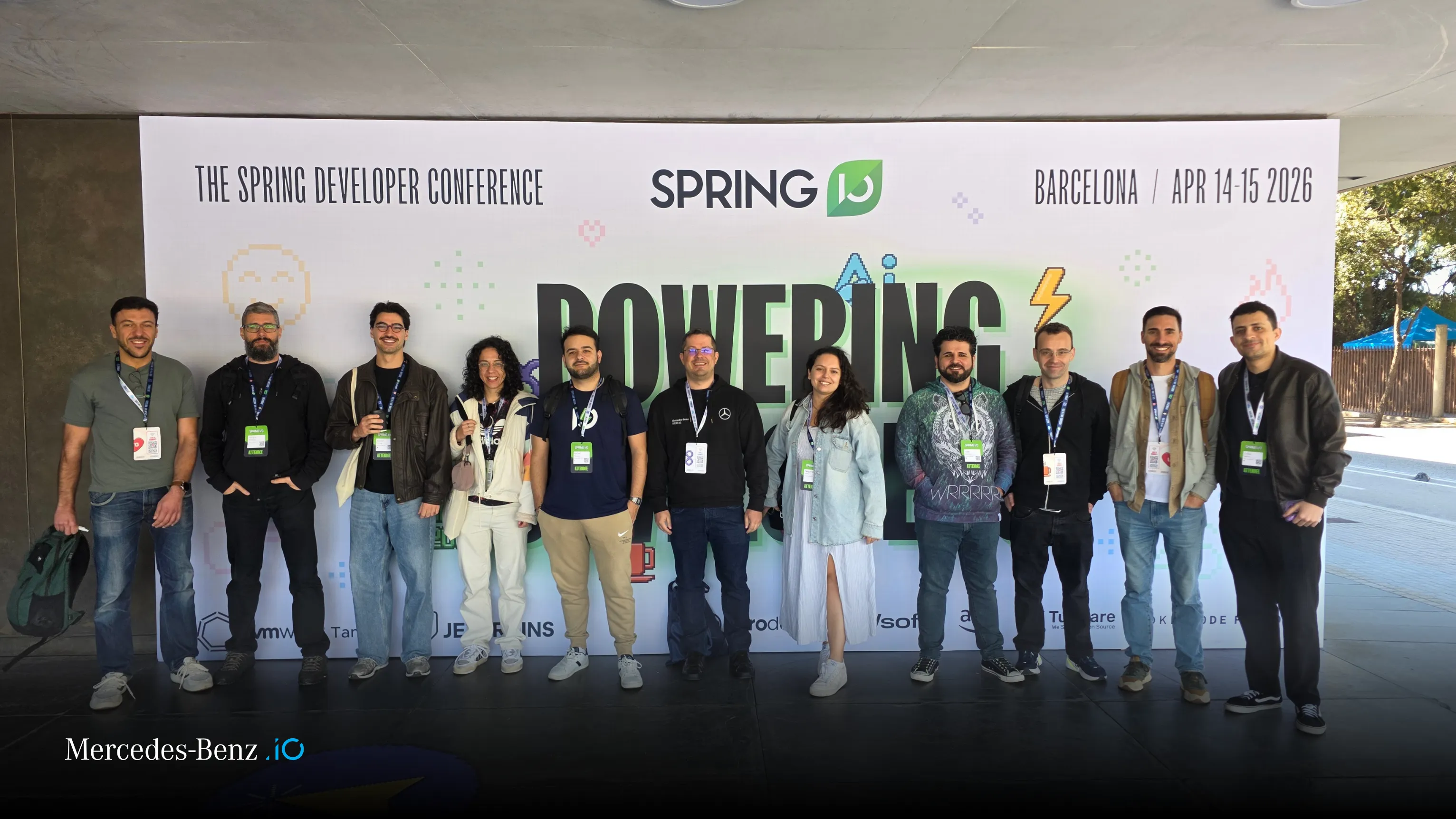
Daniel Tarita da Silva, Rafael Esteves Pereira
Spring I/O 2026: When Modern Backend Development Becomes Less About the Framework and More About the Thinking
For years, backend conferences were often defined by frameworks, architectures and technical innovation. Which pattern should we adopt? Which technology should we invest in next? Which capability will change how we build
Jul 17, 2026