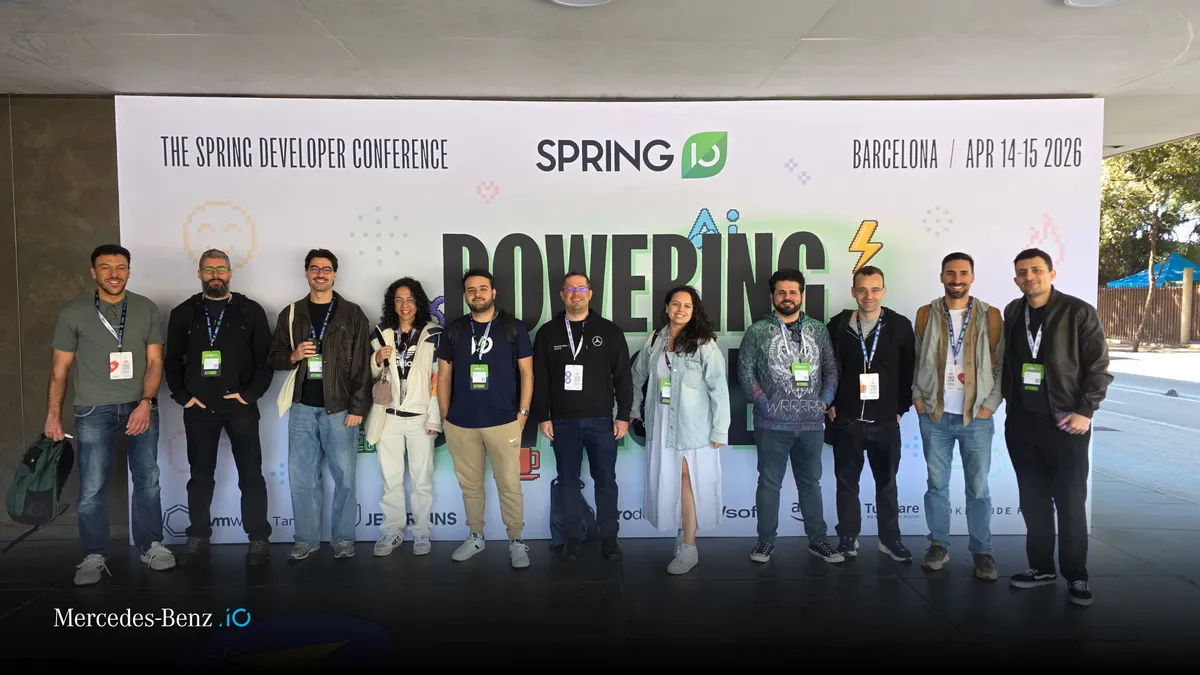
Spring I/O 2026: When Modern Backend Development Becomes Less About the Framework and More About the Thinking
For years, backend conferences were often defined by frameworks, architectures and technical innovation. Which pattern should we adopt? Which technology should we invest in next? Which capability will change how we build software? At Spring I/O 2026, the conversation felt different.

Daniel Tarita da Silva
When he was a boy, he wanted to be a firefighter. Now, he puts out fires in production.

Rafael Esteves Pereira
His daily job is writing backend code for Mercedes-Benz.io, but his favourite debugging happens under the hood of an old-school Mercedes (yes, he is working on a classic MB car).
Contents
Attending from different perspectives within Mercedes-Benz.io, Daniel Tarita da Silva and Rafael Esteves Pereira found themselves returning to a common theme throughout the event: the technology is becoming more powerful, but the real challenge is no longer the technology itself. It’s understanding the problem deeply enough to apply it well. Whether the discussion was about architecture, modernisation or AI adoption, the underlying message remained remarkably consistent: better tools raise the value of good judgement, not reduce the need for it.
When the hard part is not the architecture, but the domain
One of the talks that resonated most with Daniel came from Oliver Drotbohm’s session, “Domain-centric? Why Hexagonal and Onion Architecture are answers to the wrong question.”
Rather than debating architectural styles, the talk challenged something more fundamental: before worrying about how a system is structured, have we understood the domain well enough to draw meaningful boundaries?
That insight appeared repeatedly throughout Spring I/O. Frameworks continue to mature, best practices become more accessible, and implementation challenges become easier to solve. Yet those advances do not automatically lead to better software. Understanding users, business constraints and system boundaries remains the foundation for everything that follows.
As Daniel reflected afterwards, the hardest problems are increasingly less about choosing a framework and more about understanding why something should exist before deciding how to build it.
AI is becoming part of the application stack
While Daniel’s strongest takeaway centred on domain understanding, Rafael left Spring I/O with a different perspective shift: AI no longer feels like a separate discipline.
Much of the conversation around AI still treats it as something external to traditional enterprise development, often requiring dedicated tooling, specialised frameworks or completely different workflows. The Spring AI sessions challenged that assumption. As Rafael puts it:
The moment my Spring brain clicked into place was realizing that AI can be treated as another backend capability, just like messaging, databases, or external APIs.
That shift has important implications. Instead of introducing entirely new development approaches, Spring AI demonstrated how AI capabilities can be integrated through familiar Spring patterns and governed by the same engineering principles teams already apply elsewhere.
For Rafael, this made AI feel less like an experimental technology and more like part of the natural evolution of enterprise applications. The focus moves away from the novelty of AI itself and towards questions of maintainability, observability, security and scalability.
Automation changes the work, not the responsibility
One of the most practical discussions at Spring I/O focused on modernisation.
Daniel highlighted Raquel Pau’s session, “Hybrid Modernization: Combining OpenRewrite’s Precision with LLM Intelligence for Spring”, which explored a challenge every development team eventually faces: framework upgrades. They are frequently postponed, often unpopular, and become increasingly risky as technical debt accumulates.
What made the approach interesting was the balance between automation and human judgement.
OpenRewrite handles the predictable work: changes that are deterministic, repeatable and rule-based. LLMs assist in the areas where context, interpretation and engineering decisions are still required. Rather than replacing developers, the combination allows teams to focus their attention where it creates the most value.
The same principle surfaced elsewhere throughout the conference. As AI takes on more implementation work, clarity becomes increasingly important. Daniel pointed to Spec-Driven Development as another example of this trend, where requirements become the primary source of truth and create stronger alignment between teams. In an environment where AI-generated outputs are becoming more common, structured inputs become even more valuable.
As automation becomes more capable, the responsibility of engineers does not disappear. It shifts.
The challenge is no longer executing every task manually. It is understanding where automation helps, where judgement remains essential, and how both can work together effectively.
After Spring I/O…
Although they focused on different topics throughout the conference, Daniel and Rafael returned with remarkably complementary perspectives.
For Daniel, building applications with Spring means understanding why before defining how, creating meaningful boundaries, building reliable systems and applying AI intentionally and responsibly.
For Rafael, it means treating AI as a first-class capability of modern applications, integrated through familiar Spring patterns and supported by the same principles of maintainability, observability, security and scalability that guide every other part of the platform.
Together, their reflections point towards a future where backend development becomes simultaneously more powerful and more demanding. Frameworks continue to evolve. AI continues to accelerate delivery. But the qualities that matter most remain surprisingly familiar: understanding the problem, providing clear direction and making thoughtful engineering decisions.
Spring continues to provide exceptional tools. Our responsibility is knowing when, why and how to use them.
Related articles

Mile Grncarov
After the Hype: What Building an AI-Powered Customer Experience Taught Us
Most customers don't begin a vehicle configuration journey with a list of technical specifications.
Jul 31, 2026
Ayoub El-Moussaoui
Reliability Starts Before Production: A Site Reliability Engineer's Perspective on Building Resilient Systems
When systems fail, it is easy to focus on what happens next. How quickly can the issue be found? How fast can services be restored? How quickly can teams get everything back to normal?
Jul 28, 2026
Patricia Fernandes
Beyond Posting: Advocacy in Tech Starts Before Content
As a Social Media Specialist at Mercedes-Benz.io, Patricia Fernandes has spent years working at the intersection of technology, storytelling and employee advocacy. Through that work, she has observed a recurring pattern:
Jul 24, 2026