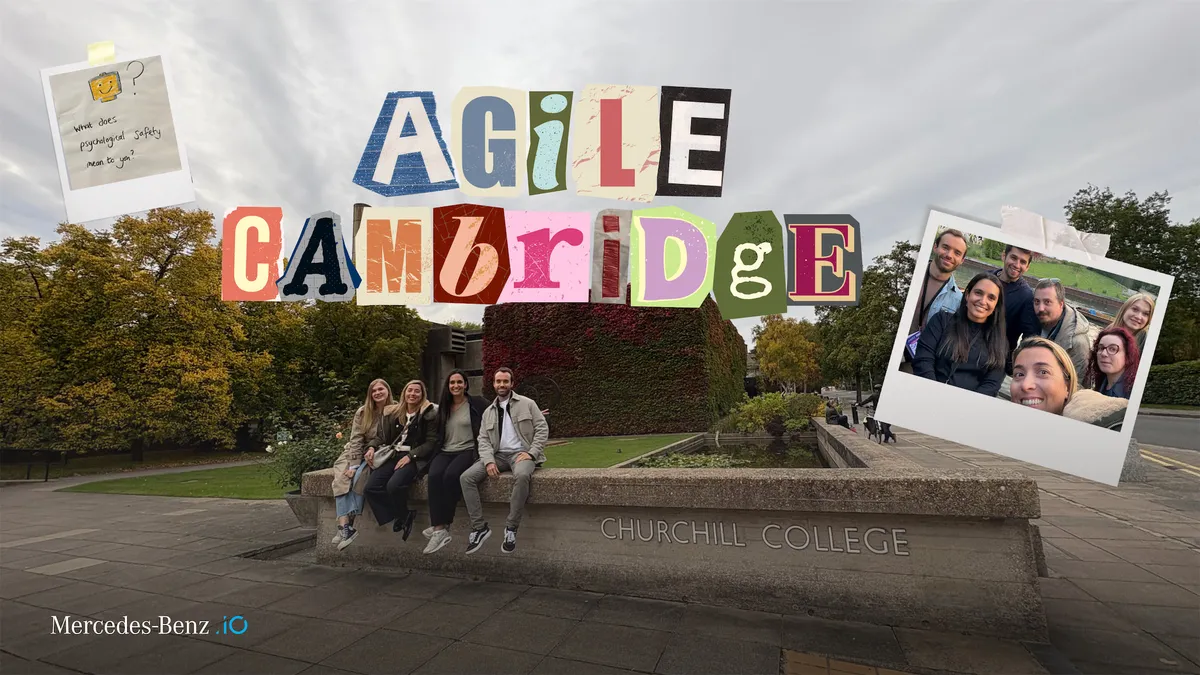
Agile Cambridge 2025: A Human-Centred Journey into Agility, AI, and Collaboration
When Vera Figueiredo, Scrum Master, stepped into Agile Cambridge 2025, she wasn’t just attending another industry event. She was entering a space that felt alive, buzzing with curiosity, openness, and a genuine willingness to share.
From the very first session, it was clear this wasn’t about repeating the same frameworks or methods. Each talk and workshop brought something new: a fresh perspective with a different lens on agility. While some sessions were deeply hands-on, others sparked thought-provoking discussions, and many encouraged interactions beyond the usual Q&A.
But one moment truly captured the spirit of the event for Vera: a workshop where participants from completely different industries came together to solve a challenge. Instead of obsessing over tools or frameworks, the conversation naturally shifted to people, empathy, and continuous learning. “It reminded me that agility is ultimately about the mindset and human connection,” she says.
Contents
The Icebreaker Revelation
Surprisingly, one of Vera’s favorite sessions was about… icebreakers. “I used to think icebreakers were uncomfortable or unnecessary,” she admits. But this session changed everything. When designed with intention, icebreakers aren’t filler, they’re powerful tools for collaboration. They help everyone speak early, level the playing field, and mentally shift from emails to engagement.
The session explored why icebreakers matter, when to use them, and how to design them so they truly support engagement rather than just fill time, and for Vera, this was a game-changer: small, intentional actions can create psychological safety and unlock participation.
Ideas That Stayed Long After the Conference
For this MB.ioneer, there was something that really got stuck in her mind: “Agility is not about the process, it’s about the people.” At Agile Cambridge, it was everywhere: in interactive sessions, spontaneous hallway conversations, and the way strangers collaborated like old friends.
Two keynote moments brought this idea to life:
Simon Wardley: “Code becomes architecture.” As generative Artificial Intelligence (AI) writes more of the code, our instructions become our intentions. Leadership now means being deliberate and keeping humans in the loop.
Jenny Martin: Psychological safety doesn’t happen by chance, we design it. Through LEGO® SERIOUS PLAY®, she showed how inclusive facilitation creates space for every voice to contribute meaningfully.
But another understanding from Agile Cambridge was about questioning old beliefs, challenging assumptions about leadership and collaboration. Jenny Martin’s approach made Vera realise that inclusion is intentional, not accidental. James Shore highlighted that unclear accountability breeds dysfunction, clarity isn’t optional; it’s essential. Jess Brock demonstrated how generative AI can free teams from repetitive tasks, giving them space for creativity. And Wardley’s insight reinforced that as AI reshapes development, leadership is about guiding with intention, not just managing processes.
The biggest shift was realising that Agility isn’t a checklist. It’s about creating the conditions where people can do their best work, for example, by fostering open communication, encouraging experimentation, and supporting continuous learning. This approach transforms abstract principles into tangible actions that help teams truly thrive.
Bringing It Back to Mercedes-Benz.io
Vera returned from Agile Cambridge inspired and eager to put specific, actionable ideas into practice. Drawing directly from the sessions and interactions at the conference, she came away with a toolkit of concrete approaches to foster agility and inclusion within her team.
-
Purposeful icebreakers to build psychological safety.
-
LEGO® SERIOUS PLAY® to help quieter voices express ideas visually.
-
Inclusive facilitation techniques like silent brainstorming and rotating ownership of discussions.
-
AI-assisted Agile practices to simplify backlog refinement and sprint planning.
-
Wardley Mapping to visualise strategy before diving into solutions.
-
Clear accountability framing to reduce ambiguity and accelerate decision-making.
Together, these practical approaches offer more than just tools; they lay out the foundation for a collaborative environment where everyone can contribute, feel valued, and achieve their best work.
A Personal Reflection
More than anything, the conference made Vera reflect on her role, that goes beyond facilitating ceremonies, and how her real impact lies in shaping spaces where people feel safe to think, speak, and create, sparking new questions:
-
How can I design interactions, so every voice is heard?
-
How can I bring clarity to accountability?
-
How can AI help us work smarter, not harder?
Her goal now is simple but with a deeper impact: experiment more, with inclusive facilitation, AI-driven practices, and a shift from process compliance to meaningful collaboration.
Agile Cambridge 2025 was a reminder that agility is human at its core and that the future of work depends on how intentionally we design for connection, safety, and creativity.
Related articles
Pedro Henriques, Ricardo Mano, +1
KotlinConf 2026: When Type Safety Meets Intelligent Systems
What happens when a language built on clarity and reliability meets a setting driven by AI and speed?
Jun 23, 2026
Karla Silva
Selenium Conference 2026: AI, BiDi, and the Future of Test Automation
From May 6 to 8, the Selenium and Appium Conference took place in Valencia, bringing together the global automation community for three days of technical discussions and knowledge sharing. Built by the community and for
Jun 12, 2026

Alexandra Teixeira
The Art of the Juggle: Balancing Business, Team and Ownership as a Product Owner
Being a Product Owner (PO) often feels like standing at the centre of multiple worlds at once. There's the business, moving fast and reacting to market pressure; and also, the team, deeply invested in the product, armed
Jun 9, 2026