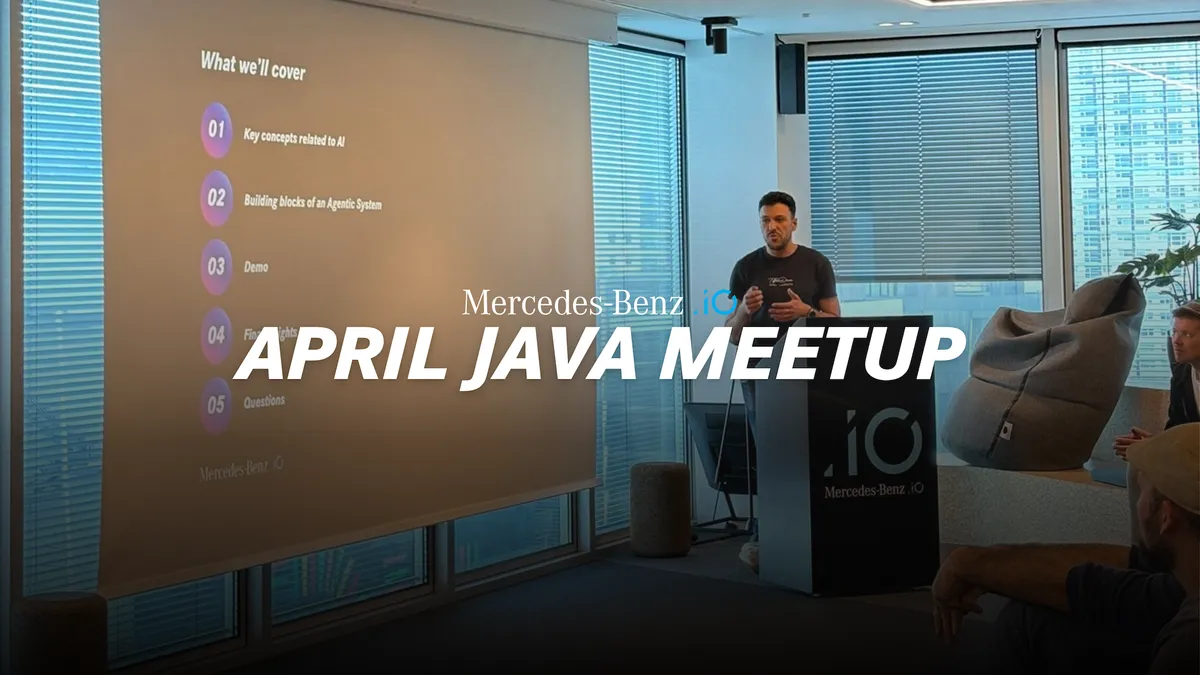
From Cool Demos to Production Reality: Insights from the April Lisbon JUG Java Meetup
At Mercedes-Benz.io, we actively engage with local and international tech communities to explore how emerging technologies can be applied responsibly in enterprise environments. In April, we were proud to take part in the Lisbon Java User Group (Lisbon JUG) Java Meetup, where André Félix presented a practical deep dive into agentic systems, focusing on what it really takes to move from impressive demos to production‑ready backend solutions.
Contents
How Do You Define an Agentic System and Why Does It Matter Today?
Agentic systems are still a very new topic, and as André Félix puts it there is not yet a single, agreed‑upon definition. What matters for development teams is understanding the most common interpretations currently used across the industry.
The most straightforward model is a single‑agent system, where one agent leverages a Large Language Model (LLM) to reason and generate responses. In this setup, the LLM is effectively “in charge”. As systems grow in ambition and complexity, this can evolve into multiple agents collaborating with one another, often through different workflow patterns producing more sophisticated and refined outcomes.
For enterprise Java teams, this distinction is essential. Whether you are designing an agentic system from scratch, or introducing generative AI into existing backend workflows, you must be clear about which model you are adopting and why. Each approach comes with different architectural, operational and governance implications and understanding this early helps teams choose the solution that best fits their specific challenge.
Beyond “Cool Demos”: The Real Challenges of Production AI
One of the central themes of André’s Lisbon JUG talk was the need to move beyond eye‑catching proofs of concept and confront the realities of production systems.
The biggest challenge teams face is entering a non‑deterministic world, and this comes across two big dimensions.
Guardrails and Enterprise Control
First and foremost, teams must ensure that agentic systems do not spiral in unexpected or undesired directions. In an enterprise context, systems must:
- Behave according to company standards
- Respect confidentiality and compliance policies
- Avoid generating unsafe or unauthorised outputs
To achieve this, guardrails are essential, regardless of how they are implemented. This can include architectural constraints, validation layers or policy‑driven controls. According to André, this is the number one concern when bringing AI agents into production.
Correctness, Tools and Reliability
The second challenge is one familiar to any backend engineer: correctness as agentic behaviour must be reliable, especially when agents interact with external tools or services.
André emphasised the importance of monitoring emerging standards while paying attention to token accuracy and efficiency. As an example, he referenced Spring AI’s “tool search tool”, which helps address both correctness and token consumption, two critical aspects for production‑grade systems.
The Role of Spring Boot and Spring AI in Production‑Ready Agents
Spring technologies played a massive role in transforming the showcased agent from an experiment into a production‑ready system.
With Spring AI 2.0 providing first‑class support for Spring Boot, development teams can introduce AI capabilities without stepping outside their established backend stack. For enterprise environments, this is a decisive advantage:
- No unnecessary learning curves
- No additional architectural complexity
- Seamless integration with existing Spring‑based systems
As André highlighted during the Lisbon JUG meetup, staying within a familiar and trusted ecosystem allows teams to focus on business value, rather than tooling overhead.
One Key Lesson from Building Agentic Systems
If teams take just one lesson from André’s journey is that the path to production will have bumps.
The AI ecosystem is evolving rapidly, with new frameworks, patterns and standards emerging almost daily. In this environment, the real challenge is not about experimentation but more focused on intentional adoption.
André recommends that you start by identifying valuable ways to use AI, then develop plans to ensure these can be maintained in the long term and make sure to include teams and stakeholders from the beginning.
Endless proofs of concept may look impressive, but without a long‑term vision they quickly become a mirage. Production‑ready agentic systems require strategy, collaboration and patience.
The April Lisbon JUG Java Meetup offered a valuable reality check on agentic systems: powerful, promising and demanding when done properly. André Félix’s session showed that success lies not in chasing hype, but in carefully integrating AI into proven enterprise architectures.
Related articles

Romina Muenchow-Centili
AI in Service Management: Driving Efficiency, Quality and Impact
Artificial Intelligence (AI) is no longer a distant promise in Service Management, it is already reshaping how teams work, think and deliver value. In this edition of Technkowledgy, Romina Muenchow-Centili, Service Manag
May 12, 2026

João Almeida
Behind the Engine: How Carl.AI Scales Knowledge Access at Mercedes-Benz.io
At Mercedes-Benz.io, not every product we build is visible to customers. Some of the most important ones work quietly behind the scenes, shaping how teams collaborate, share knowledge, and build digital products more eff
Apr 28, 2026

Fagner Jesus, Flávio Moringa
KubeCon + CloudNativeCon: How Platform Engineering Is Shifting from Tools to Intent
KubeCon + CloudNativeCon is never just about Kubernetes, but more about where the cloud‑native ecosystem is heading next, technically, organisationally, and culturally. This year, Mercedes‑Benz.io was represented by seve
Apr 24, 2026