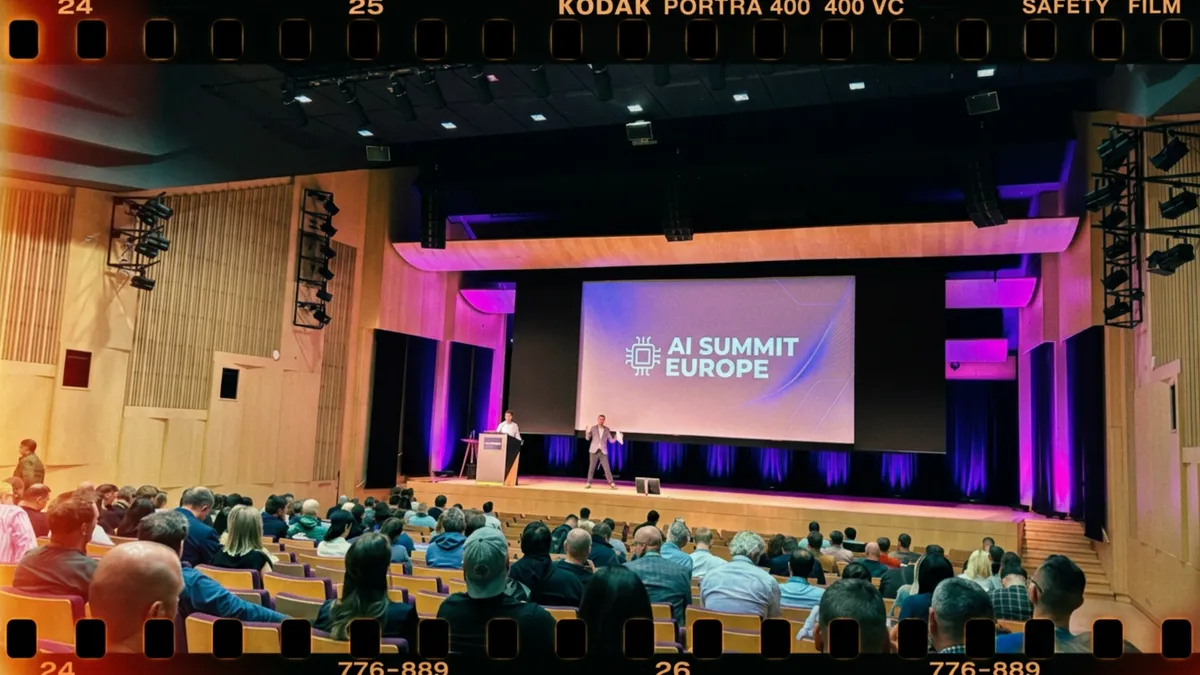
AI That Works: What our MB.ioneers Brought Back from AI Summit Europe
At the AI Summit Europe, Mercedes-Benz.io was represented by our MB.ioneers Bruno Ferreira and André Varandas, who returned not only with inspiration, but with clear, practical insights on how AI needs to be built, governed, and scaled in real-world organisations. From accountability and agentic systems to the urgency of adoption, their reflections highlight a shift away from experimentation towards engineering responsible, production-ready AI.
Contents
Rethinking AI Ownership: From Abstract Ethics to Concrete Accountability
One of the most impactful sessions for Bruno Ferreira was the panel “Who Owns the Decision? Governance, Guardrails and Accountable AI”. The discussion reframed governance from a theoretical debate into something far more tangible: ownership.
AI governance, as highlighted, is about clear accountability for decisions and outcomes. Who signs off on what goes into production? Who owns the risks? Who is responsible when AI behaves unpredictably?
A key challenge remains unresolved across the industry: who owns AI outputs? In practice, outputs are rarely created in isolation. They emerge from a combination of:
- Proprietary data
- Prompt design
- Third-party models
This layered responsibility makes ownership, liability, and intellectual property increasingly complex. As Bruno observed: “governance must be treated as a core system design concern, not an afterthought.”
What stood out the most, however, was the tone in the room. The conversation went beyond compliance, touching on a deeper commitment to protecting people and the planet, this is a sign that responsible AI is becoming a shared industry mission.
When It Clicks: AI as Systems, Not Features
For both, a major shift came from understanding how AI should be structured in practice.
Bruno Ferreira highlights a pivotal moment during the session “Mastering AI-Driven Agentic Development: Lessons from the Frontlines”. The key realisation?
AI agents are not “smart chatbots”, they are software components with boundaries.
This shift from demos to systems brings significant implications:
- AI must be designed like microservices that reason
- Tooling, constraints, and logging are part of the product, not optional extras
- Evaluation and validation must be embedded from the start
A particularly powerful pattern discussed was “agents validating agents”, where outputs are reviewed by a secondary AI acting as a critic. This introduces:
- Built-in quality assurance
- Reduced hallucination risk
- Peer-review-like validation loops
At the same time, companies are already building shared instruction layers: reusable prompts, guardrails, and behavioural guidelines that ensure consistency across teams. This avoids duplication and standardises AI behaviour organisation-wide.
However, one concern remains: cost. Running multi-agent systems with long context windows is resource-intensive. While some organisations are deferring this conversation, Bruno points out that ignoring cost now may create scalability challenges later.
Quality at the Core: Validation Is No Longer Optional
For André Varandas, the biggest shift was not tied to a single talk, but a broader realisation across multiple sessions:
Validation must sit at the heart of AI development.
AI systems cannot be trusted by default. Instead, they must be continuously validated at every stage, especially in agentic workflows, where errors often happen in transitions between steps.
This means:
- Testing is no longer a final step, it is ongoing
- Output validation must be embedded throughout pipelines
- System reliability depends on controlling each interaction boundary
This insight reinforces a critical principle: AI quality is engineered, not assumed.
From Strategy to Execution: A Structured Approach to AI Adoption
Beyond technical insights, the conference also highlighted a practical framework for implementing AI in organisations. The proposed layered approach to AI adoption emphasises that successful AI depends on process maturity:
Process Readiness Comes First
Before introducing automation, organisations must ensure:
- Standardisation: clearly defined processes
- Digitalisation: reliable data capture and infrastructure
- Automation: only after the first two are in place
Skipping directly to automation often leads to inefficiency and poor outcomes.
From Framework to Action
To operationalise AI, three critical steps were highlighted:
- Define goals and KPIs: Focus on measurable outcomes, not tools
- Select tools and build agents: Align capabilities with needs
- Plan and implement change: Redesign workflows, train teams, and govern systems
This final step, change management, is frequently overlooked, yet it determines whether AI adoption succeeds or fails.
Regulation vs. Innovation: Finding the Balance
A recurring tension throughout the Summit was the role of regulation in Europe. André Varandas candidly reflects on the challenge:
While Europe demonstrates strong ethical instincts, increasing complexity around compliance raises a critical question:
Are we protecting users, or slowing innovation while others set global standards?
Despite this tension, the takeaway is not to wait. Regulation will evolve, but organisations must continue learning by doing.
The reflections from AI Summit Europe converge on a shared mindset shift:
Bruno Ferreira:
Working with AI means engineering accountable socio-technical systems, not chasing model hype: measurable outcomes, explicit ownership, and guardrails built into the architecture from day one
André Varandas:
Working with AI means not waiting. Those who act now will lead; those who hesitate will follow.
Final Thoughts: From Hype to Responsibility
AI is no longer about experimentation or showcasing capabilities. It is about building systems that are reliable, accountable, and scalable.
AI Summit Europe reinforced one essential truth: The future of AI will not be defined by the most powerful models, but by the organisations that learn how to use them responsibly and effectively at scale.
Related articles

Karla Silva
Selenium Conference 2026: AI, BiDi, and the Future of Test Automation
From May 6 to 8, the Selenium and Appium Conference took place in Valencia, bringing together the global automation community for three days of technical discussions and knowledge sharing. Built by the community and for
Jun 12, 2026

Alexandra Teixeira
The Art of the Juggle: Balancing Business, Team and Ownership as a Product Owner
Being a Product Owner (PO) often feels like standing at the centre of multiple worlds at once. There's the business, moving fast and reacting to market pressure; and also, the team, deeply invested in the product, armed
Jun 9, 2026

Cassia Tofano, Rita Saraiva
From UX Rotterdam 2026 to Mercedes-Benz.io: Reflections on AI, Strategy and the Future of User Experience
At UX Rotterdam 2026, Cassia Tofano and Rita Saraiva immersed themselves in a program rich with forward-thinking perspectives on the future of user experience. Their key takeaway: as artificial intelligence transforms de
Jun 5, 2026