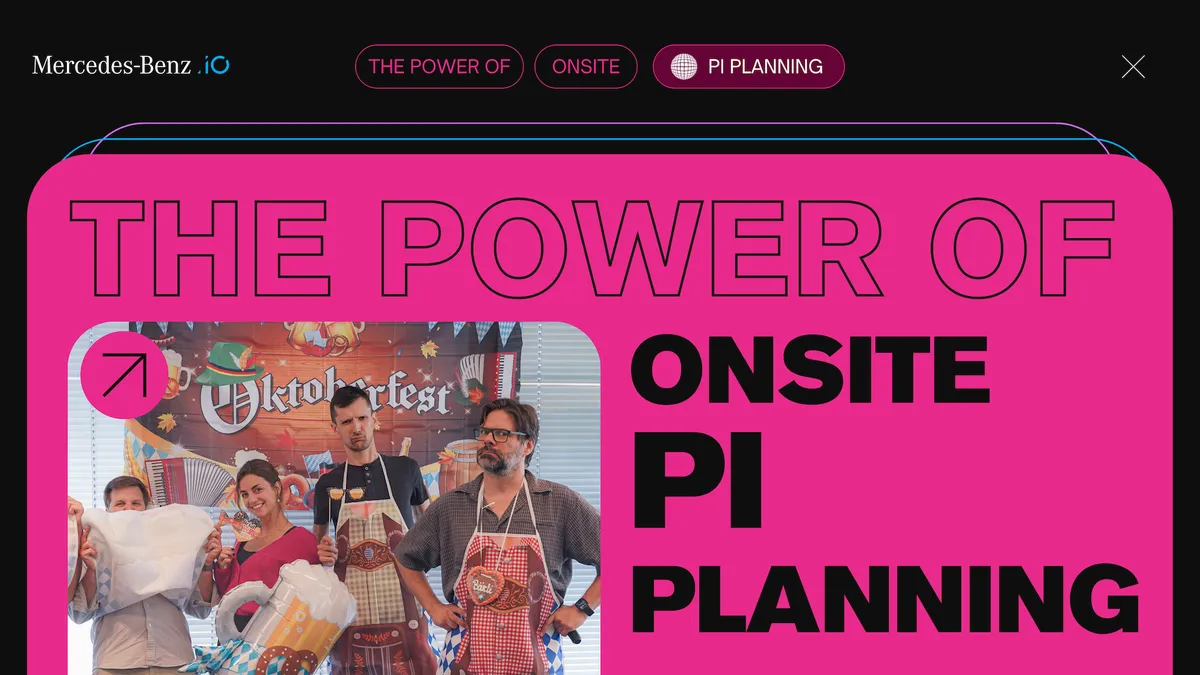
The Power of Onsite PI Planning
Some moments are better when shared in the same room. PI Planning is one of them. Being onsite brings more than in-person collaboration, but also brings renewed energy, context and connection. For a few days, the plan switches to strategy and a shared mission.
When teams gather in the same space, something shifts, not only does the planning feel different, but focus sharpens and conversations flow. And for these few days, alignment doesn’t just happen, it sticks.
That’s exactly what happened to Sina Langjahr during the last onsite PI Planning at Mercedes-Benz.io.
Contents
There’s a Reason It’s Called Planning Together
In theory, a digital setup can replicate the agenda but, in practice, being onsite unlocks something else entirely.
“When we’re together, conversations flow faster, and alignment happens more naturally,” Sina shared. “People are more open, more focused, and there’s less room for misunderstanding.”
You feel the difference when people sketch out ideas side by side, bounce thoughts off each other without booking a meeting, or align priorities in real time and avoid waiting for synchronisations or follow-ups that happen afterward.
The Energy You Can’t Stream
It’s hard to describe what it’s like until you’re there.
It’s about the small moments that can make the biggest impact, or the spontaneous whiteboard session that bring clarity. But it’s also about the relaxed laugh during a tight deadline or that team picture during a break that ends up becoming your new favourite. Because these shared moments are where trust is built and that’s why the work moves forward more smoothly after the session ends.
“You feel the vibe,” Sina said. “The connection, the focus, the little side conversations. It’s that shared experience you just can’t replicate on a screen.”
Trust Isn’t Assigned, It’s Built
A strong PI Plan relies on clarity, ownership, and realistic expectations just as much as it depends on trust, which isn’t built by reading Jira tickets but through real, in-person experiences.
“Trust grows faster when you share moments together, a meal, a laugh, or even a stressful session,” Sina explained. “Those shared experiences create a deeper understanding of each other’s strengths and communication styles.”
In the long run, trust becomes the invisible scaffolding of effective collaboration: helping people to speak up, supporting each other, and giving them the confidence to challenge ideas with honesty and care. Sina noted how much stronger the feeling of connection was onsite.
Also, speaking to another MB.ioneer and Train Released Engineer involved in this PI, Filipa Anjos, added that being physically together also opens the door to deeper personal connections. “At the last PI in Germany,” she shared, “the people staying at the same hotel played simple personality games in the evening and it really helped them get to know each other beyond work.”
So… Why Do We Still Do It?
No matter how great the tools are, the real work happens between the teams, with clarity of alignment. This becomes more evident, especially a face-to-face collaboration, sharing the same room, and in a context where you connect with people beyond the screens.
“People are the heartbeat of every ART,” Sina put it simply. “When we bring teams together, we’re not just planning, we’re connecting. And that makes a difference.”
First Time Joining a PI Planning Onsite?
The first tip is clear: come prepared, that doesn’t mean you need to have all the answers, but with curiosity and an open mind. This will allow you to ask the right questions. And the other tip is enjoying the opportunities. This means, joining the chats during coffee breaks, sketching new ideas, laughing at something, or noticing something you wouldn’t have been able to if you were joining online
PI Planning isn’t just about crafting a perfect plan; it’s about building the relationships that make the plan work.
Yes, remote tools are powerful. Yes, hybrid work is here to stay. But sometimes, the best strategy isn’t just what we plan, it’s how we come together to plan it and that’s something we’re not ready to give up.
Related articles
Patricia Fernandes
Beyond Posting: Advocacy in Tech Starts Before Content
As a Social Media Specialist at Mercedes-Benz.io, Patricia Fernandes has spent years working at the intersection of technology, storytelling and employee advocacy. Through that work, she has observed a recurring pattern:
Jul 24, 2026
Philipp Tegethof
Diversity Diaries: Building Belonging Every Day
As Pride Month comes to an end, Philipp Tegethof, Head of People & Culture at Mercedes-Benz.io, reflects on what Pride truly represents, not only for the LGBTQIA+ community, but for all of us as colleagues, leaders and M
Jul 21, 2026
Daniel Tarita da Silva, Rafael Esteves Pereira
Spring I/O 2026: When Modern Backend Development Becomes Less About the Framework and More About the Thinking
For years, backend conferences were often defined by frameworks, architectures and technical innovation. Which pattern should we adopt? Which technology should we invest in next? Which capability will change how we build
Jul 17, 2026